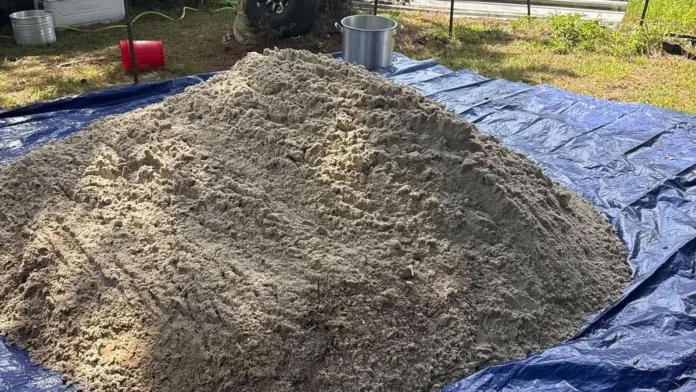

A delivered load of sand on a tarp in a Livingston Parish yard. Photo: Acadian Services.
Livingston Parish homeowners know how much water decides the shape of a yard. The National Weather Service recorded 25.52 inches of rain at Livingston during the August 2016 flood, and NOAA’s Climate.gov reported the Amite River at Denham Springs cresting at 46.2 feet, almost five feet above the old 1983 record.
A lot of yard work here starts with a load of material: filling low spots, rebuilding beds, laying paths, and patching lawns. Most of those jobs need one to four cubic yards of material, which is too much for a few bags from the store and too little for a full dump truck. Ordering the right amount is mostly arithmetic.
Start With Three Measurements
Bulk material is sold by the cubic yard, so the first step is converting your project into that unit. Measure length and width in feet and decide how deep the material needs to be in inches.
Texas A&M AgriLife Extension publishes the formula most suppliers use: length in feet times width in feet times depth in inches divided by 12, then divide the result by 27. A 10-by-12-foot flower bed topped with 3 inches of mulch works out to about 1.1 cubic yards.
The same math scales up quickly. A 40-foot garden path 3 feet wide and dug 4 inches deep needs roughly 1.5 cubic yards. Patching a 20-by-25-foot section of lawn with 4 inches of topsoil takes a little over 6 cubic yards, which is already more than one small trailer load.
How Deep Each Material Should Go
Depth drives the order more than area does, so it pays to get it right before calling anyone. Guidance varies by project:
- Mulch: HomeAdvisor’s 2026 mulching guide recommends 2 to 3 inches for beds.
- Topsoil for new grass: Penn State Extension recommends 4 to 6 inches of good-quality topsoil, firmed or settled, to establish a healthy lawn.
- Gravel paths: This Old House’s 2026 gravel path guide digs out about 4 inches and lines the trench with roughly 2 1/2 inches of crushed stone pack before the top layer goes down.
Round up slightly when you order. Loose material settles, and a second delivery for a quarter yard almost always costs more than the extra material would have.
Why Weight Matters More Than Volume
A cubic yard does not sound like much until you see what it weighs. Engineering ToolBox density tables put loose dry dirt at about 76 pounds per cubic foot and dry gravel at about 105, which converts to roughly 2,050 and 2,835 pounds per cubic yard.
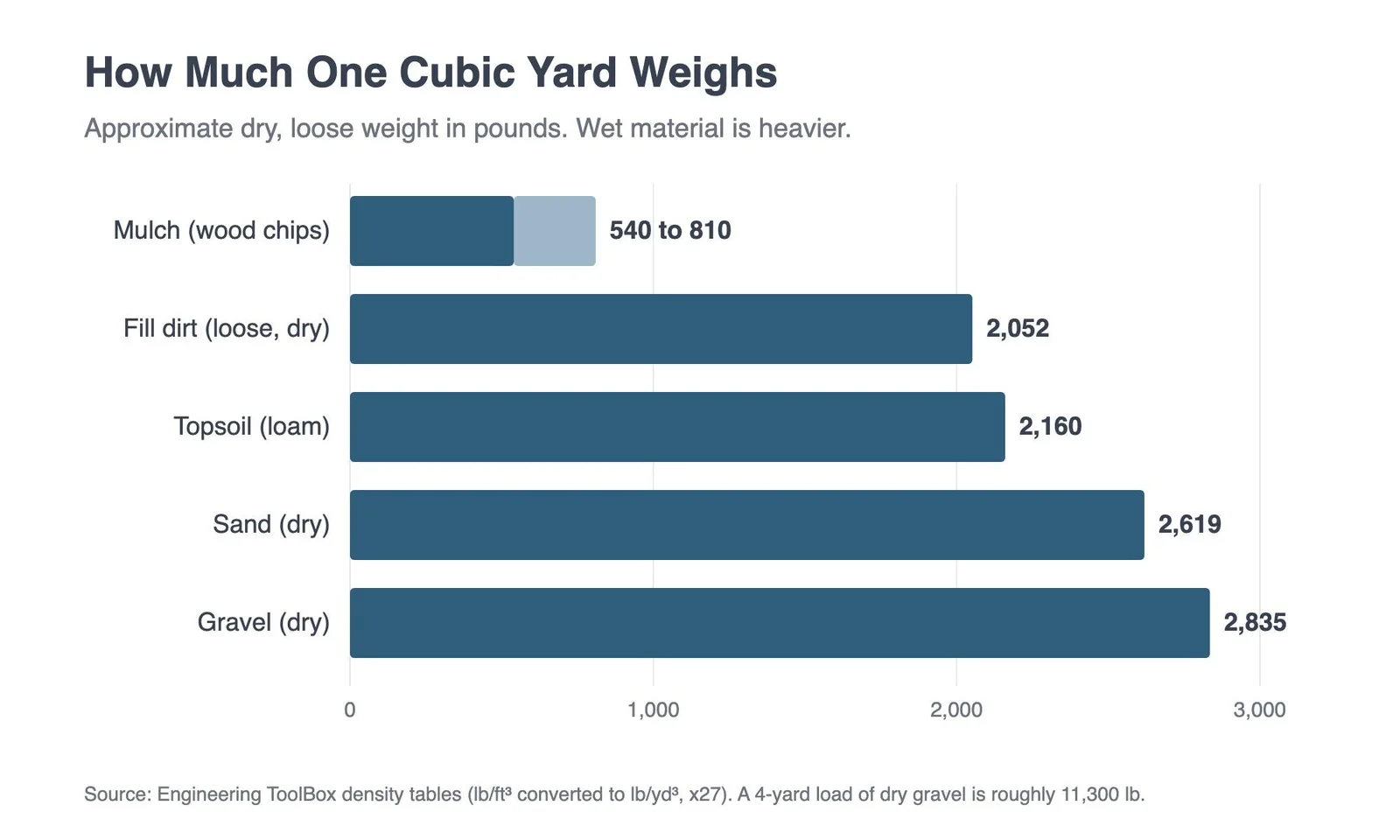
Approximate dry weight per cubic yard. Source: Engineering ToolBox density tables, converted from pounds per cubic foot.
That means a 4-yard load of dry gravel weighs around 11,300 pounds, and the same volume of dry sand weighs about 10,500. Wet material is heavier still. Michigan State University Extension notes that a full-size pickup bed holds about 2.5 cubic yards, but at those weights, the bed is the easy part. This is why small loads usually arrive in a dump trailer rather than the back of a truck.
What Small Loads Cost
National pricing offers a useful starting point, though local quotes will vary. HomeAdvisor’s fill dirt cost guide, updated in June 2026, lists these ranges per cubic yard: fill dirt $5 to $30, topsoil $12 to $55, sand $15 to $40, gravel $20 to $120, and mulch $50 to $150.
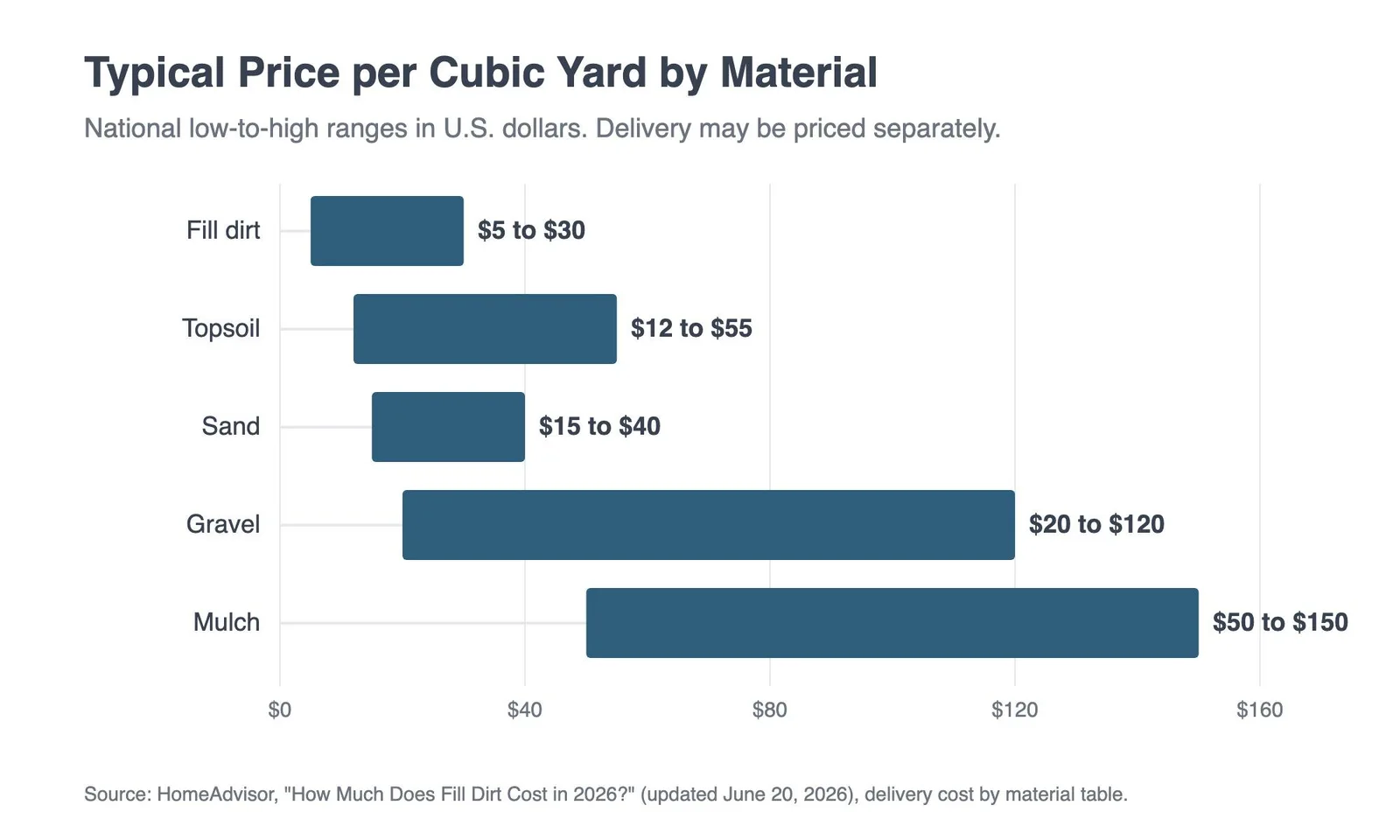
National price ranges per cubic yard. Source: HomeAdvisor, updated June 20, 2026.
The same guide notes that some providers fold delivery into the per-yard price while others list it separately, and that haulers without a set delivery fee may charge $65 to $100 per hour. Many also have a minimum order. When you compare quotes, ask for one number that covers material, distance, and drop-off.
Local haulers can make this simpler. For example, Acadian Services prices dirt and gravel delivery in Denham Springs by material, volume, and distance, with four yards as the working limit for a single trip.
Before the Load Shows Up
A little preparation keeps a delivery from turning into a mess. Pick the drop spot ahead of time, as close to the project as a trailer can safely back in. Lay a tarp on grass or a driveway so the pile is easy to shovel and cleanup takes minutes, not an afternoon.
Check overhead lines, soft ground after rain, and any low branches along the path in. Point out septic tanks, sprinkler heads, and drain lines so nothing heavy rolls over them.
If the plan is to raise a low area, check flood rules first. Livingston Parish’s permit office handles flood zone determinations, and The Advocate reported in July 2026 that the parish council adopted a new development code covering how construction handles drainage and flooding. A short call before placing fill is cheaper than moving it twice.
Plan for the Leftovers
Even careful estimates leave a little extra, and some projects create material instead of using it. Digging out a path or a patio base can leave a pile of soil and old rock behind.
Spread small amounts into beds or low corners where they will not change drainage toward the house. For anything larger, ask the hauler who delivered the material whether they also take away excess soil and rock.
Where the Small-Load Market Is Heading
The arithmetic is simple, but the pricing behind it is not standardized. National guides publish ranges wide enough that gravel alone spans $20 to $120 a yard, and the same guide that lists those numbers notes that delivery may or may not be included. For a homeowner ordering two or three yards, that spread matters more than the material itself.
Small loads also sit in an awkward gap. They are too heavy for most personal vehicles and smaller than the loads full-size dump trucks are built to carry, leaving room for one-truck haulers using trailers. That gap may grow in parishes where new subdivisions keep adding yards that need finishing.
Drainage adds a local layer. Livingston Parish’s council adopted a new development code covering drainage and flooding this year, but the line between filling a backyard low spot and changing how a property drains isn’t always obvious to a homeowner. Clearer guidance from parish offices and more consistent all-in pricing from haulers would make these small orders far easier to get right the first time.


