
A vehicle title is easy to forget until someone asks for it. A buyer wants it at the sale, a loan gets paid off, or a move means registering the car in another state. That is often the moment an owner realizes the paper is gone.
Louisiana has a defined fix. The state issues a replacement called a duplicate title, and the rules for who can request one and what to bring are written into the Office of Motor Vehicles policy.
A Title Is Paper, and Louisiana Is Hard on Paper
Louisiana has millions of titled vehicles. The Federal Highway Administration’s Highway Statistics table MV-1 counts 4,556,436 motor vehicles registered in the state in 2024.
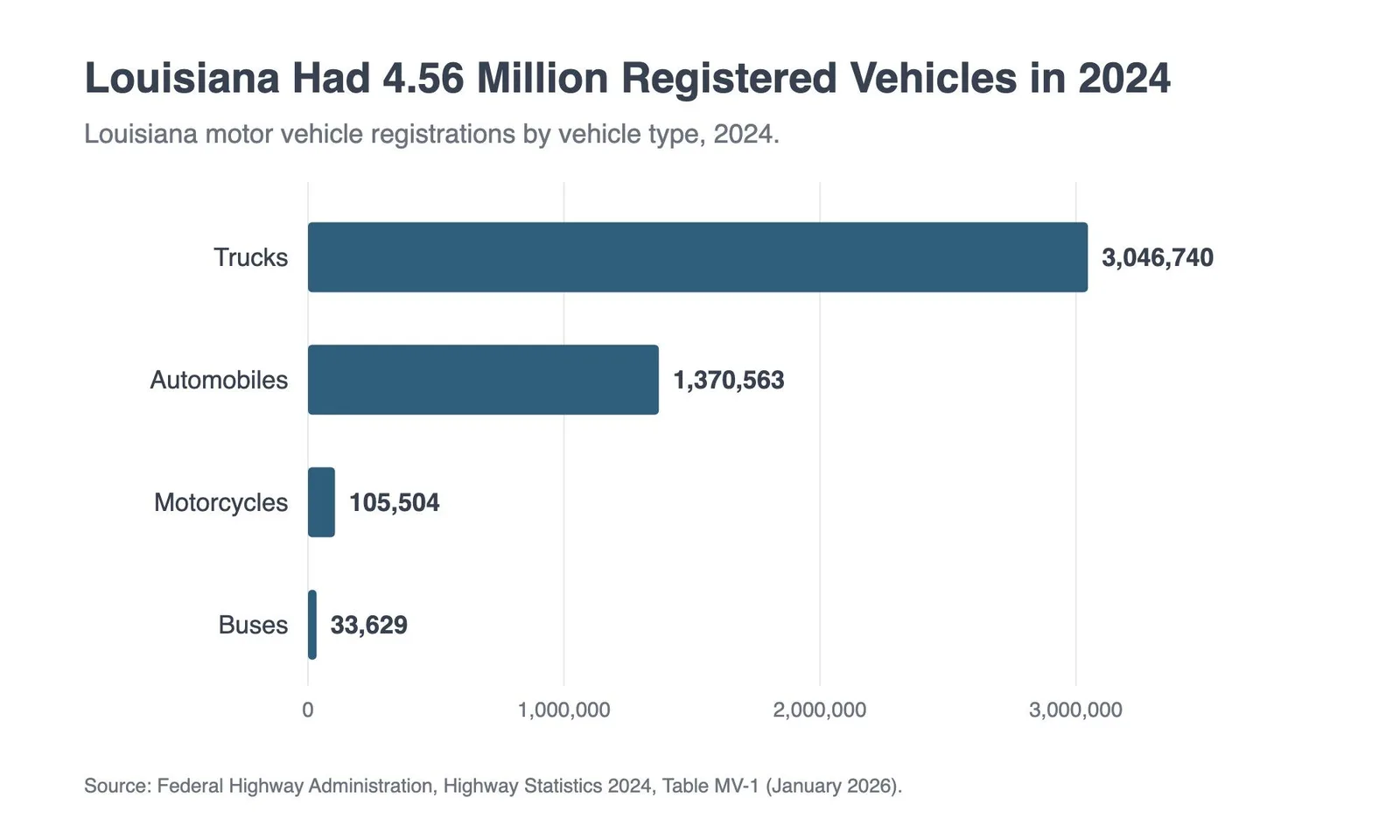
Louisiana had more than 4.5 million registered motor vehicles in 2024.
That total includes 3,046,740 trucks and 1,370,563 automobiles. Each vehicle has a title record behind it, and many paper titles sit in a drawer, a glove box, or a file box for years.
The weather adds risk. NOAA’s National Centers for Environmental Information counts 106 weather and climate disasters with losses of more than $1 billion each that affected Louisiana from 1980 to 2024.
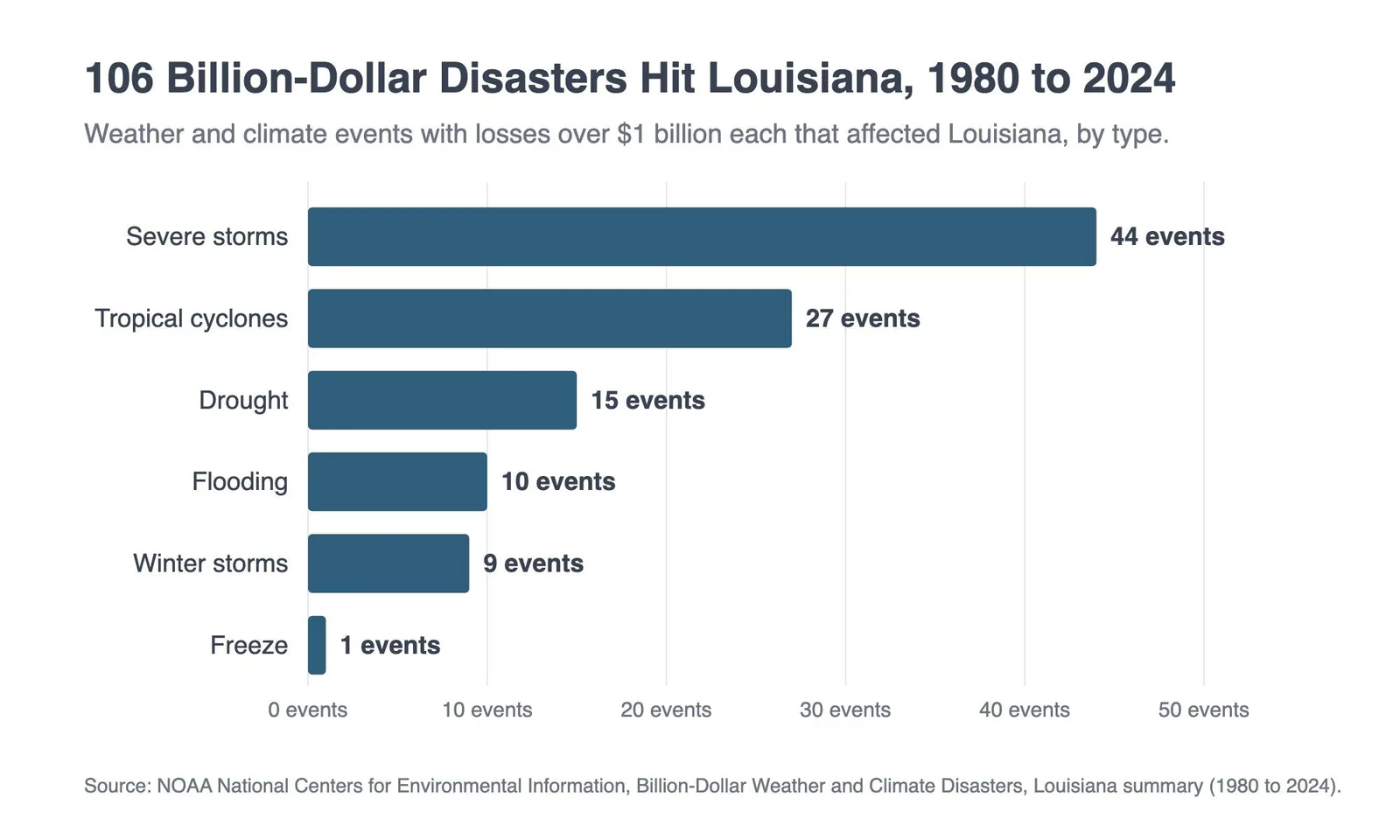
Severe storms and tropical cyclones make up most of Louisiana’s billion-dollar disasters.
Severe storms account for 44 of those events and tropical cyclones for 27, with 10 flooding events on top of that. The pace has picked up, too. NOAA puts Louisiana’s 1980 to 2024 average at 2.4 such events a year and its 2020 to 2024 average at 6.8, adjusted for inflation.
NOAA’s entry for the May 2021 flooding describes damage to thousands of homes, vehicles and businesses in Baton Rouge and Lake Charles after more than 12 inches of rain. A title kept in a house that took on water can be ruined even when the car was parked somewhere dry.
The Quieter Ways a Title Disappears
Storms are the dramatic case, but plenty of titles go missing in ordinary ways. The state’s own list of reasons is short: OMV guidance says a duplicate can be issued when the original has been mutilated, lost, destroyed, or never received.
In practice, that covers a lot of everyday situations:
- A title packed during a move and never unpacked.
- A title that went to a lender during a loan and was never located after payoff.
- A title that never arrived in the mail after the vehicle was registered.
- A title that is torn, faded, or water-stained past the point of being accepted.
Owners usually notice at the worst time, in the middle of a sale or a trade-in, so it helps to know the requirements before that day arrives.
What the OMV Requires for a Duplicate Title
The rules come from Louisiana Office of Motor Vehicles Policy 15.00 on duplicate titles, last revised in April 2024. It limits applicants to the registered owner, the owner’s agent, or the lienholder.
The core document is the Vehicle Application, form DPSMV 1799, including a duplicate title affidavit section that must be completed and notarized. The policy allows the application to be signed in front of an OMV employee or a public tag agency employee in place of notarization.
Someone other than the owner can sign only in specific roles. The policy names a person holding a power of attorney or mandate, a court-appointed curator for an interdicted owner, a bankruptcy trustee, and a company representative who lists their position on the application.
A short checklist based on the policy:
- A completed Vehicle Application, form DPSMV 1799.
- The duplicate title affidavit on that form, signed and notarized or signed before an OMV or public tag agency employee.
- The original power of attorney or a certified true copy, if someone is signing for the owner.
- Proof that any old loan was paid off, if a lien appears on the record.
- A notarized statement or DPSMV 1799 authorization, if the duplicate should be mailed to a different address.
One limit catches families off guard. Policy 15.00 says a duplicate cannot be issued in a deceased owner’s name unless the owner completed and notarized the duplicate title affidavit before death.
How an Old Car Loan Affects the Request
Liens add the most paperwork. If the record still shows an unpaid lien, the lienholder must complete a notarized affidavit of non-possession, and the duplicate title is mailed to the lienholder instead of the owner.
If the loan is paid off, the owner needs proof. The policy accepts the original note stamped paid, a satisfaction of lien from the lienholder on company letterhead showing its name, address, and telephone number, or a notarized affidavit of satisfaction signed by a lienholder representative.
That document must describe the vehicle completely, including the make, model year, and vehicle identification number. The policy also says a lienholder’s name cannot be changed during a duplicate title request, so a loan buyout is handled separately.
What the State Charges
The cost question has a short answer on the state side. The OMV’s published fee schedule lists a title fee of $68.50 and a handling fee of $8.00 among its most common charges, and it notes that other fees are available on request.
A lost registration certificate is a separate, simpler request. The OMV lists a $12 fee for a duplicate registration, plus a local fee of no more than $8, and accepts those requests online, by mail, or in person.
Owners using an office other than the state OMV should ask about any parish fees or service charges before the visit, since the state schedule covers only state amounts.
Using a Public Tag Agent
Louisiana also allows licensed public tag agents to process title work. Title Authority LLC, a privately owned, authorized public tag agent (PTA #399) in Covington, is one licensed public tag agent that handles requests for a duplicate vehicle title in Louisiana. Its page says staff fill out the OMV form, review it for accuracy and notarize where required, that processing typically takes 7 to 10 business days depending on OMV times, and that expedited next-business-day pickup is available when all paperwork is correct and complete.
Keeping the Next Title Out of Harm’s Way
A replaced title is only as safe as the place it is kept. Storing it in a dry, waterproof spot inside the home, away from the vehicle, protects it from theft and flooding.
After a loan payoff, owners can confirm the lien release has been recorded and keep the release with the title. A photo or copy of both documents makes the vehicle identification number and lien details easy to find later.
In a state with millions of titled vehicles and a long record of storms, a lost title is a common problem. The duplicate process is well-defined, and owners who gather the form, the notarized affidavit, and any lien paperwork first usually have the smoothest request.


