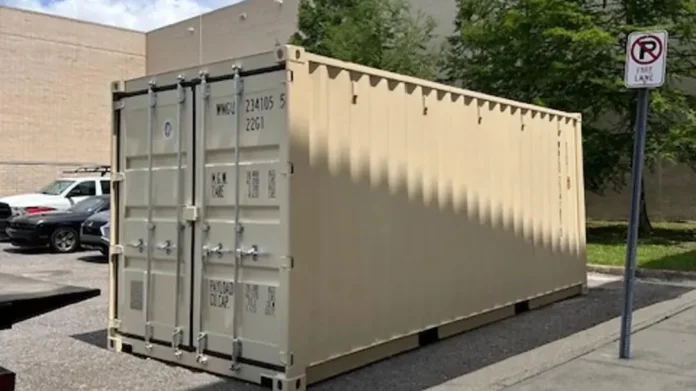

A job site in the Baton Rouge area has two problems that never take a day off. Something is always being built, and something is always getting rained on.
Tools, drywall, lumber, and boxed fixtures spend nights and weekends on site between deliveries and installs. Where they sit during those hours shapes how much gets lost, ruined, or reordered.
A Steady Pipeline of New Job Sites
The Baton Rouge metro keeps many residential projects open at any moment. The Census Bureau’s Building Permits Survey tracks new privately owned housing units authorized by permit, metro by metro, and its final 2025 figures came out in May 2026.
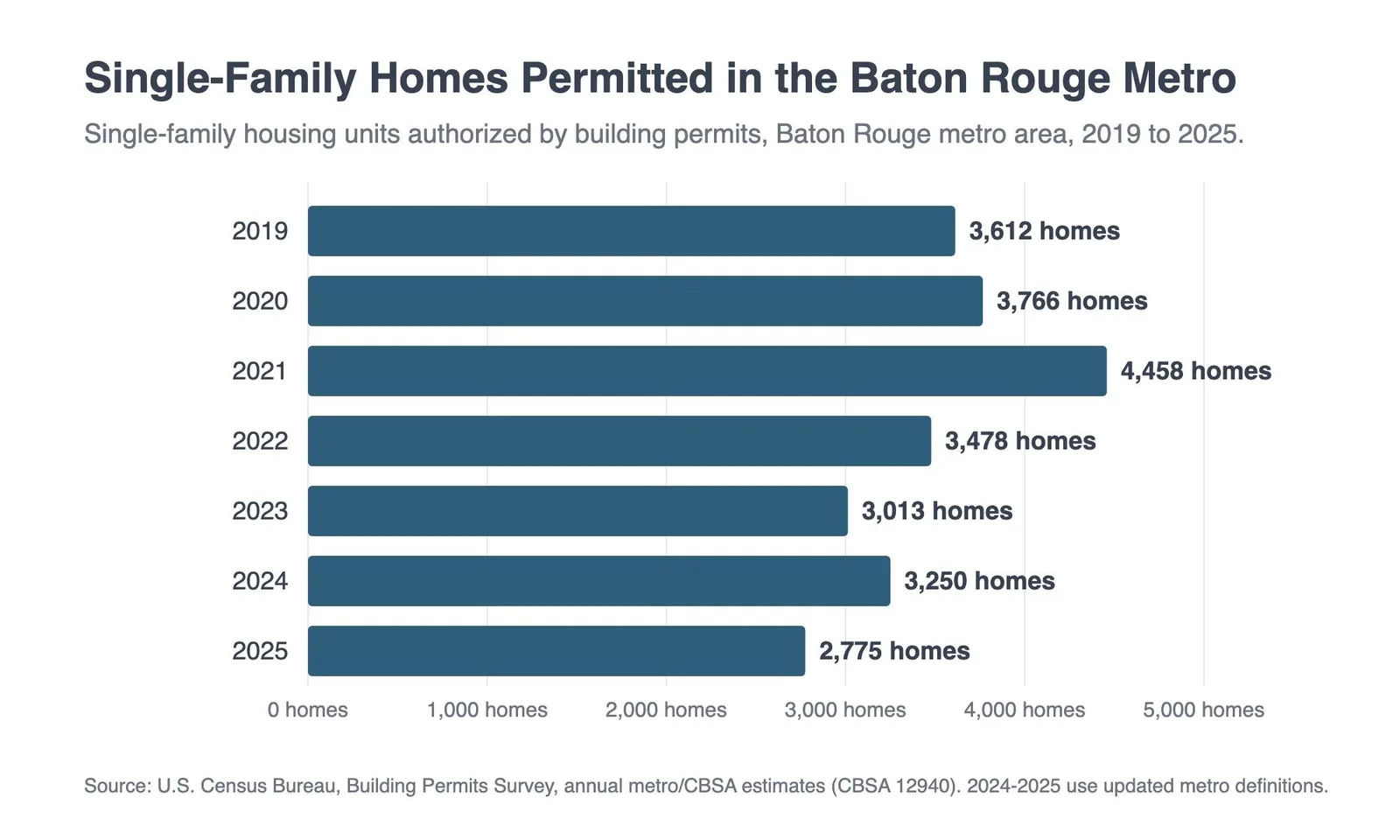
Single-family homes authorized in the Baton Rouge metro, 2019 to 2025.
Single-family permits in the metro peaked at 4,458 units in 2021. They have eased since, to 2,775 in 2025, but the seven years from 2019 through 2025 still add up to more than 24,000 single-family homes, by our count of the annual figures.
Multifamily work moved the other way in 2025. Total units authorized reached 4,314 that year, and 1,517 of them were in buildings with five or more units.
One caution on the trend line. The Bureau began publishing metro data under updated area definitions starting with 2024, so comparisons across that change are approximate.
Every Permit Is a Storage Decision
Each of those authorizations turns into a site where materials arrive before they are needed. Framing packages, roofing bundles, windows and cabinets often show up days or weeks ahead of the crew that installs them.
Small tools travel with workers, but much of the kit does not. Generators, saws, ladders, compressors, and partial pallets stay behind when the last truck leaves.
On a single-family lot, that usually means a garage that does not exist yet, a tarp, or the bed of a trailer. On a multifamily site, the volume grows, and so does the number of people moving through the property after hours.
Storage on site also has to share space with everything else. Dumpsters, portable toilets, material drops, and parked trucks all compete for the same patch of driveway or staging area.
How Often Rain Reaches an Open Site
The weather side of the problem is easy to underestimate. NOAA’s U.S. Climate Normals for Baton Rouge Metropolitan Airport put average precipitation at about 62 inches a year for 1991 to 2020.
The yearly total matters less to a superintendent than how many days get wet. The same normals count the average number of days that reach each rainfall threshold.
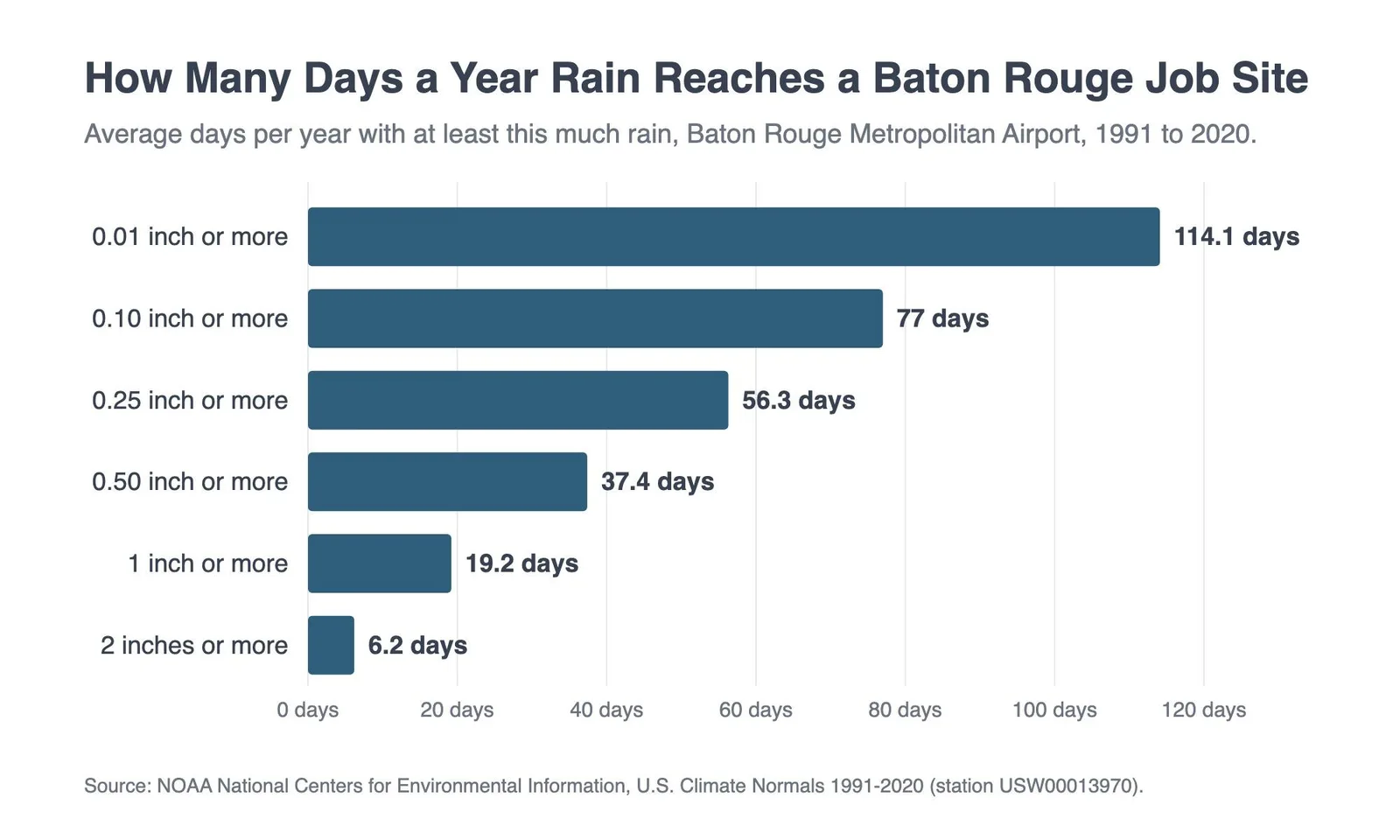
Average days per year that reach each rainfall amount in Baton Rouge.
Measurable rain falls on about 114 days in a typical year, close to a third of the calendar. Rain of a tenth of an inch or more, enough to soak cardboard and pool on a tarp, comes on about 77 days.
By our arithmetic, that is roughly a day and a half each week. Days with an inch or more average about 19 a year, and days with 2 inches or more about six.
What Wet Storage Costs a Project
Water damage on a job site rarely looks dramatic. It shows up as drywall that softens at the edges, insulation that will not dry in time, and boxed fixtures whose packaging falls apart before install day.
Lumber left uncovered can swell, twist, or stain. Power tools that sit in standing water or high humidity may corrode at the contacts and switches, and fasteners can start to rust in open boxes.
Each of those problems usually ends the same way. Someone reorders material, waits for it, and the schedule slides by the length of the delivery window.
The losses also stack across trades. A framing crew that finds wet sheathing on Monday morning holds up the roofer, who holds up the window installer, who holds up the drywall crew behind them.
Security follows the same pattern. Gear out of sight and behind a locked steel door is a harder target than gear under a tarp beside the street.
Tarps, Trailers and Lockable Boxes
Builders in the area tend to rely on a few familiar setups, each with trade-offs. Tarps over pallets are cheap and quick, but wind can lift them, and they offer no security.
Enclosed trailers lock and keep rain off, but space is tight, and the trailer is tied up on one site. Storing materials off site keeps them dry but adds trips and handling for every delivery.
A steel container on site keeps materials dry and lockable within walking distance of the work. The right choice depends on how long the project runs, how much material needs cover at once, and how much room the lot has for a footprint.
A practical checklist for a Baton Rouge site:
- Plan where moisture-sensitive materials will sit before the first delivery, not after it rains.
- Keep drywall, insulation, and boxed finishes off the ground and fully enclosed.
- Set storage on firm, level ground that does not collect runoff.
- Lock tools and equipment at the end of every shift, including short days.
- Match the storage footprint to peak deliveries, not average ones.
- Leave room for a truck to drop and retrieve the unit without blocking other trades.
Container Sizes for Job Sites
Shipping containers have become a common answer on longer projects because they combine a lock, a roof, and a fixed footprint. Size is the main decision, and it follows the scale of the job.
In Baton Rouge, Load and Geaux Portable Storage is one company that describes its job site storage containers in Baton Rouge in those terms. Its 20-foot and 40-foot containers are built from Corten steel with lockable doors, and the company says it delivers to the site and picks up on the customer’s schedule. It lists about 1,175 cubic feet of space in the 20-foot unit and about 2,385 cubic feet in the 40-foot unit, which it suggests for staging lumber, pipe, and heavy equipment. The company also notes the containers can serve as on-site offices, workshops, or break rooms.
Where Job Site Storage in South Louisiana Is Heading
The numbers behind the problem are not likely to change soon. Permits show thousands of new homes and apartment units authorized in the Baton Rouge metro each year, and the climate normals show rain arriving on roughly one day in three.
That makes storage less of an afterthought and more of a line in the site plan. Deciding where materials sleep, and how they stay dry and locked, belongs next to deciding when they arrive.


