

The Baton Rouge area has thousands of registered charities. Federal records show that most of them are small, and many report no revenue figure to the IRS at all.
That matters for how local causes raise money. A group without a development staff or a large donor base may lean on events, from raffles to dinners to golf contests, to fund its work.
Where the Numbers Come From
The IRS publishes its Exempt Organizations Business Master File as a set of state files. The agency calls it a cumulative file holding the most recent information it has for each organization. The latest posting is dated October 13, 2026.
The Louisiana file lists 24,098 exempt organizations. Of those, 19,490 are 501(c)(3) groups, the charities, schools, churches, and foundations that can receive tax-deductible gifts.
The file lists a mailing ZIP code, not a parish. To sort records by parish, each ZIP code was matched to the 2020 Census ZIP Code Tabulation Areas and assigned to the parish that holds the largest share of its land area.
Two limits apply. The IRS says the address generally reflects an organization’s headquarters, which may not be where it works. And 375 area records use post office box ZIP codes with no Census match, 307 of them in Baton Rouge, so the counts below are a floor.
East Baton Rouge Holds Two Thirds of the Region’s Charities
Across East Baton Rouge, Livingston, Ascension and Tangipahoa parishes, the file lists 3,322 charities under section 501(c)(3).
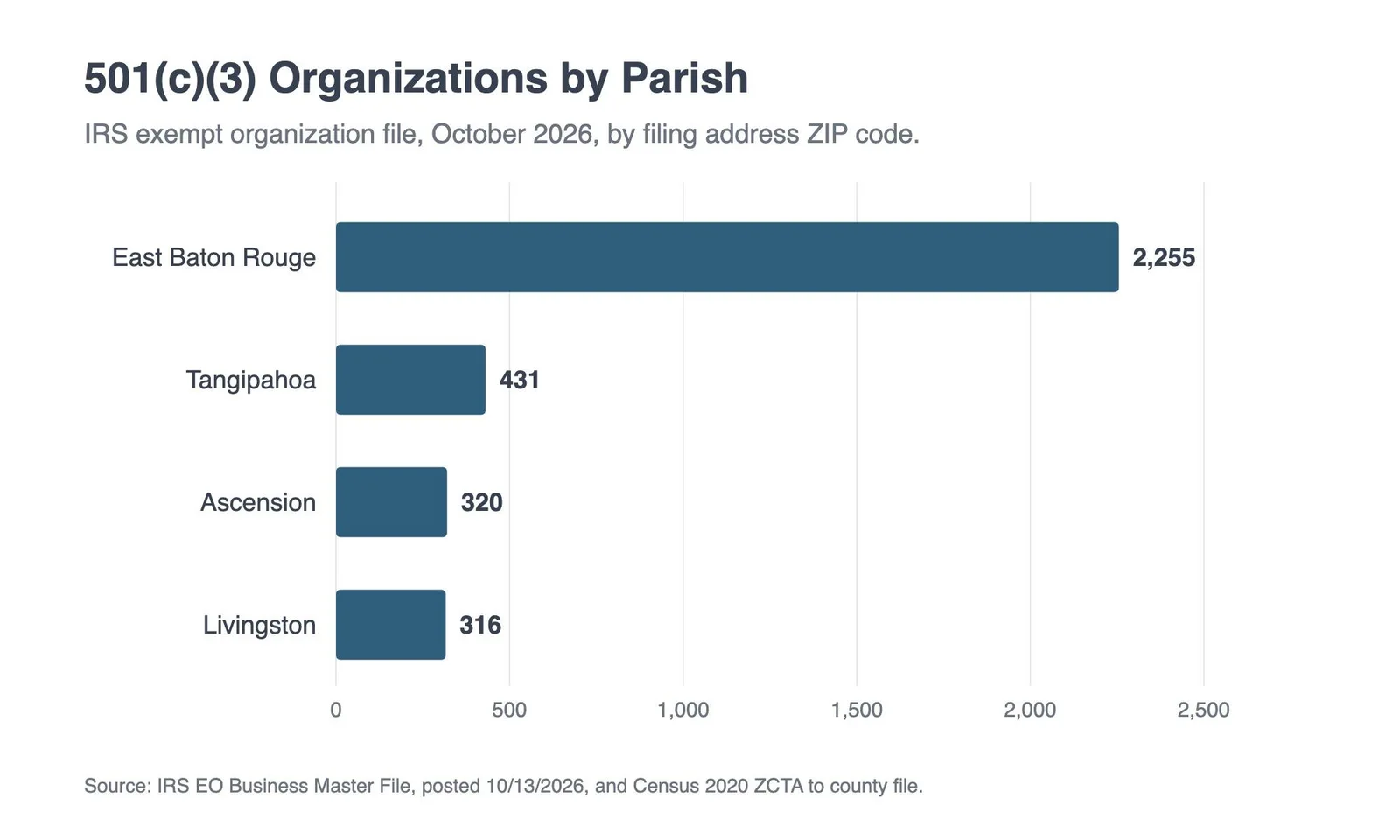
501(c)(3) organizations by parish, October 2026.
East Baton Rouge accounts for 2,255 of them, about 68% of the four-parish total by our arithmetic. Tangipahoa follows with 431, then Ascension with 320 and Livingston with 316.
The suburban parishes have far fewer charities, but their mix is weighted even more toward small groups, as the revenue figures show.
More Than Half File the Smallest IRS Return
The clearest size signal in the file is the filing requirement code. Code 02 marks organizations required to file Form 990-N, which the IRS file describes as income less than $50,000 per year.
Across the four parishes, 1,838 charities carry that code, or 55% of the total. The share is 54% in East Baton Rouge, 58% in Livingston, 59% in Ascension, and 58% in Tangipahoa.
Form 990-N is a short electronic notice. It does not report revenue, so these groups show no dollar amount in the revenue field.
What the Revenue Field Shows
The file’s revenue amount comes from the most recent full Form 990 or 990-EZ. For many groups, that field is blank or zero.
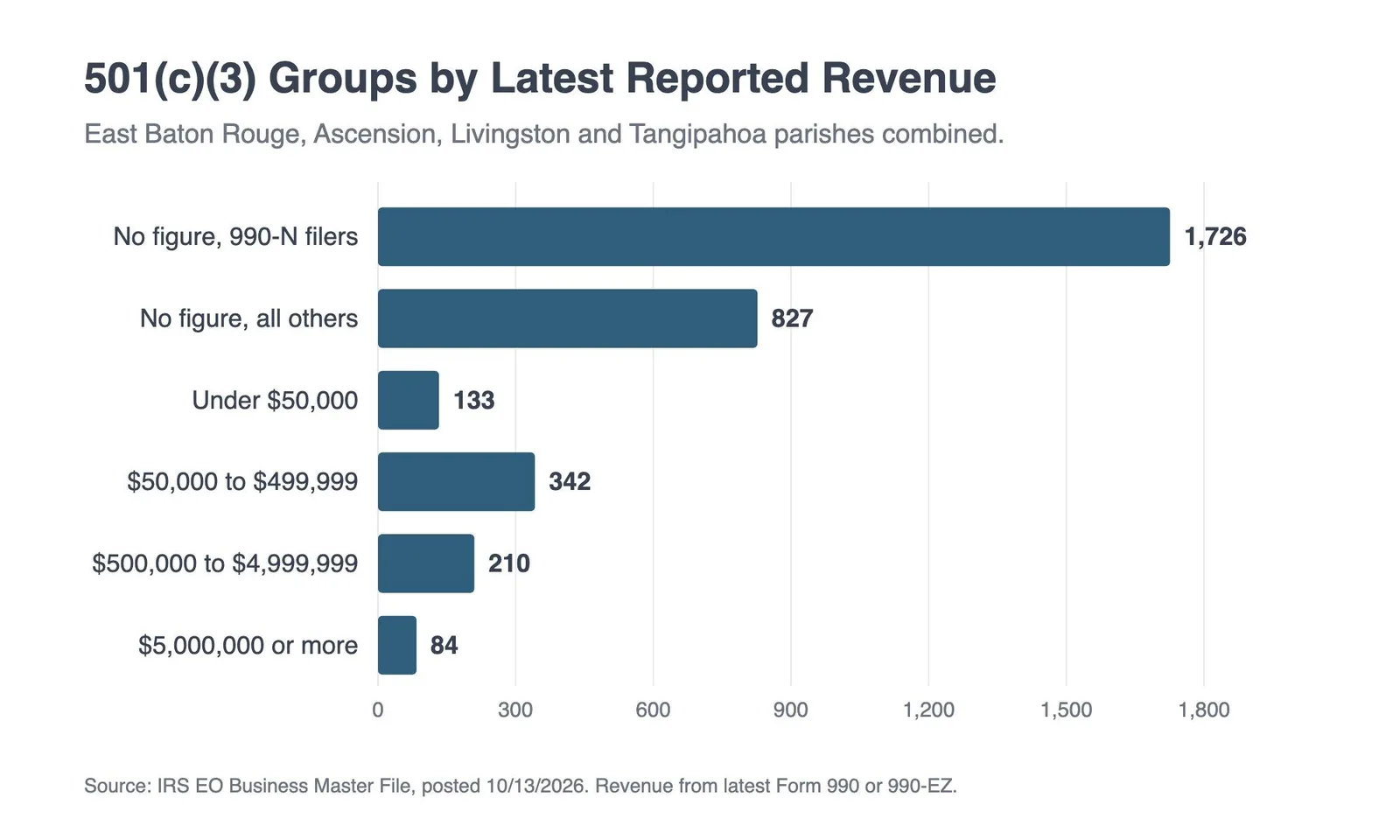
501(c)(3) groups by latest reported revenue, four parishes combined.
In this analysis, a blank and a zero were treated the same way, as no revenue figure on file. That group totals 2,553 organizations. Most are 990-N filers, and 583 are churches, which are not required to file.
A missing figure does not prove a group is small. Churches and some other non-filers can be large, and 61 organizations in the no-figure group carry an IRS income code of $100,000 or more.
Counting groups that reported revenue under $50,000 together with those that have no revenue figure, the share comes to 78% in East Baton Rouge and between 85% and 87% in each of the other three parishes. Only 294 charities across the region, about 9%, reported revenue of $500,000 or more.
Event Fundraising Comes With Federal Rules
Ticketed dinners, contests and auctions all trade something of value for a donation, and federal tax rules address that exchange directly.
IRS Publication 1771 says charitable organizations “are required to provide a written disclosure statement in quid pro quo charitable contributions where donors receive goods or services in exchange for a single payment in excess of $75.”
The publication gives an example. A donor pays $100 for a concert ticket with a fair market value of $40, so the deduction “may not exceed $60.” The statement has to include a good faith estimate of that value and be made in a way likely to come to the donor’s attention.
Auctions have their own guidance. An IRS page on charity auctions says a buyer may deduct only “the excess of the purchase price paid for an item over its fair market value,” and suggests a catalog with good faith estimates of each item’s value.
Organizers can check with a tax professional on how these rules apply to a specific event, such as a contest entry or a sponsorship package.
Golf Contests Without a Course
A charity golf tournament usually takes a course, a date, and a full field of players. A simulator moves the contest indoors instead.
Riverside Fairways is one company that describes a golf simulator fundraiser on its website. It says the format brings the contest to a hall, gym, or pavilion, with guests paying per attempt at longest drive or closest to the pin.
The company says a sponsor can underwrite the activity, and that a simulator session can be offered as a live or silent auction lot. It lists venue needs of electricity, 15 by 20 feet of floor space, 12 feet of ceiling clearance, and a level surface.
A Small Group’s Checklist
None of this requires a large budget. It mostly requires planning the event and the paperwork together.
A practical starting point for a Baton Rouge area charity:
- Confirm the organization’s current status and filing code in the IRS file.
- Set a fair market value for anything a donor receives, from a dinner to an auction item.
- Prepare a written disclosure for any single payment over $75 that buys goods or services.
- Publish value estimates for auction items before bidding starts.
- Keep records of sponsors, entries and auction sales for the next return.
With more than half of the region’s 3,322 charities filing the smallest IRS return, a single event can carry real weight in a group’s budget. The federal rules travel with it.


