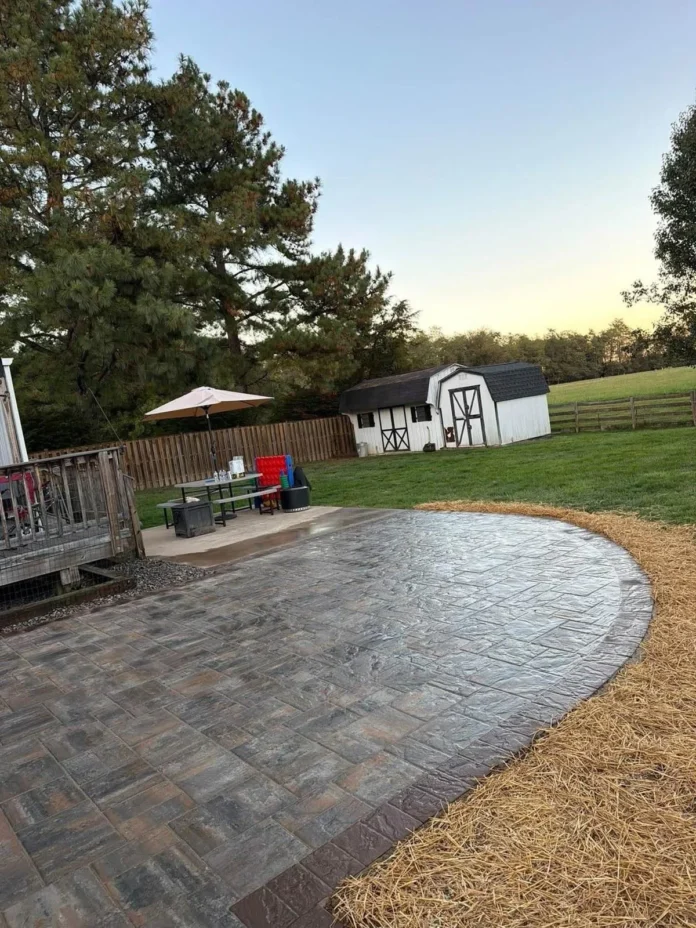

Frederick County rarely stays frozen for long, and that is exactly the problem for anything built on the ground. A patio in Frederick, Walkersville or Urbana can be frozen overnight, thawed by the afternoon sun, and frozen again the next night, dozens of times between November and March.
The numbers come from the federal government’s long-term climate record. NOAA’s 1991-2020 U.S. Climate Normals for the weather station at the Frederick Police Barracks show an average of 83.6 days a year when the low temperature reaches 32°F or colder. On only 8.9 of those days does the high also stay at or below freezing. That leaves roughly 75 days a year when the air temperature drops to freezing overnight and climbs back above it during the day. Soil a few inches down lags behind the air, but the pattern is the one that matters for a patio: repeated crossings of the freezing line rather than one long freeze.
For homeowners planning a paver patio, a walkway or a low retaining wall, that cycle is the single most useful fact about local weather.
Why a freeze followed by a thaw matters more than a deep freeze
Water expands by about 9% when it freezes. When soil under a patio holds water and that water freezes, it pushes upward. When it thaws, the soil settles back, but not always evenly, and not always to the same place. Repeat that 75 times a winter and small differences add up: a paver edge that sits a quarter inch proud of its neighbor, a walkway that tilts toward the house, a step that rocks underfoot.
Each crossing of the freezing line is another chance for that movement. It is the repeated cycling, which climbs through December, peaks in January and stays high through February and much of March in Frederick, that works a poorly built base loose.
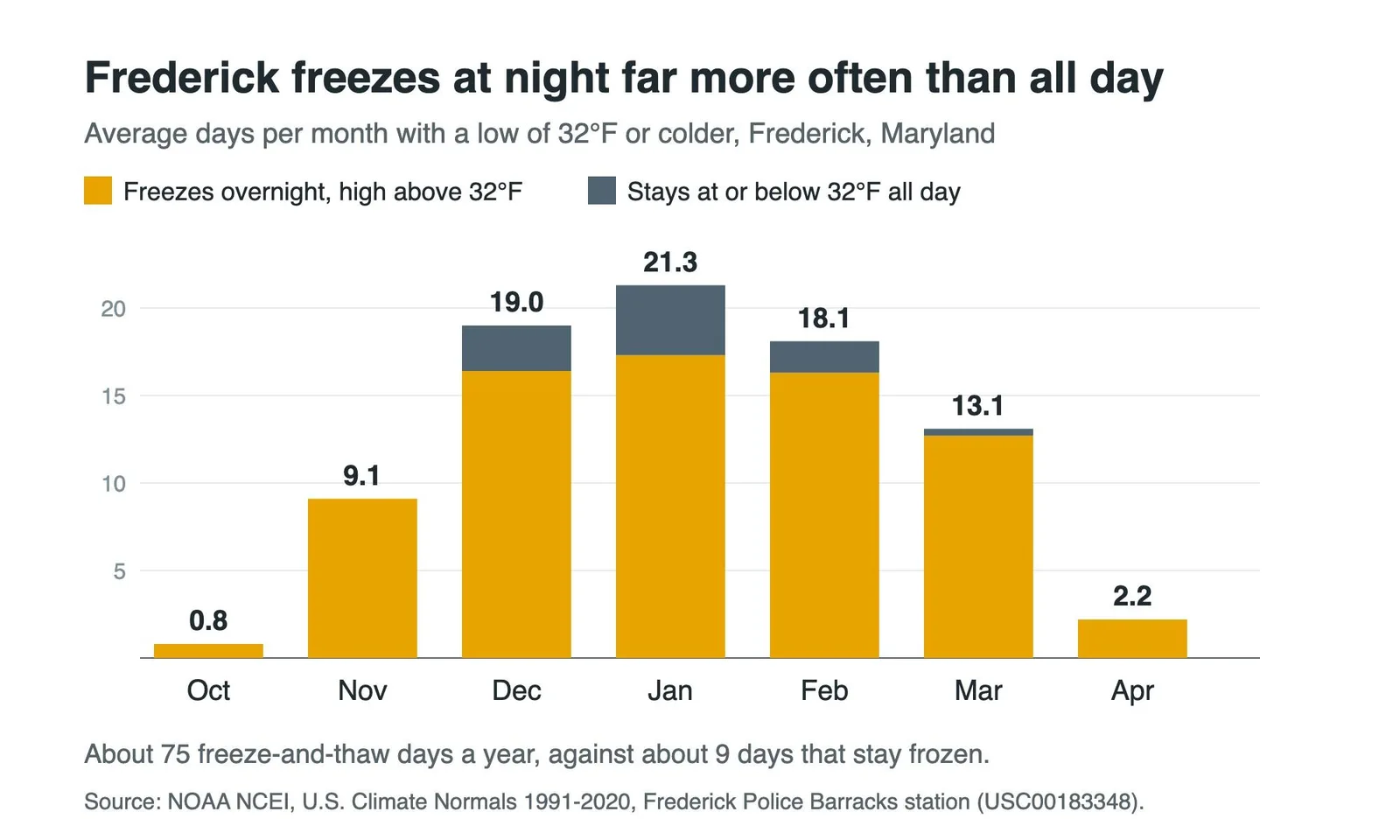
Average monthly freezing days in Frederick, Maryland. Data: NOAA NCEI, U.S. Climate Normals 1991-2020.
The monthly breakdown shows how concentrated the season is. December, January and February each average 16 to 17 days that freeze overnight and climb above 32°F during the day. November and March add about 9 and 13 more. October and April each average fewer than three freezing nights.
The three ingredients of frost heave
Frost heave needs three things at once: freezing temperatures, soil that holds water, and a supply of water to feed it. Nobody controls the first. Homeowners and the contractors they hire have a great deal of control over the other two.
That is why the part of a patio nobody sees after installation, the layer of compacted crushed stone beneath the pavers, carries most of the responsibility for how the surface looks five winters later. Clean, angular stone drains water down and away instead of holding it against the underside of the pavers. Compacting it in thin layers keeps it from settling unevenly once loads and freezing begin.
Practitioners in colder places take this further. Writing in Fine Homebuilding in 2021, Vermont stoneworker and landscape architect Brian Post described digging about 16 inches below finished grade for a stone patio, while noting the depth can be reduced in areas with hard soil and no ground frost. He also wrote that heaving is caused by freezing water and tree roots, and recommended filter fabric over erodible soils such as silt and loam so the soil does not wash into the stone. Frederick’s winters are milder than Vermont’s, but the logic is the same: the colder the climate and the wetter the soil, the more of the work happens below the surface.
Water is the part homeowners can see
Precipitation is the other half of the equation. The same NOAA normals put Frederick’s average annual precipitation at 43.52 inches. September is the wettest month on average, at 5.80 inches, followed by June at 4.26 inches. Winter months still bring about 2.6 to 4 inches each, often as rain or melting snow on ground that is already near freezing.
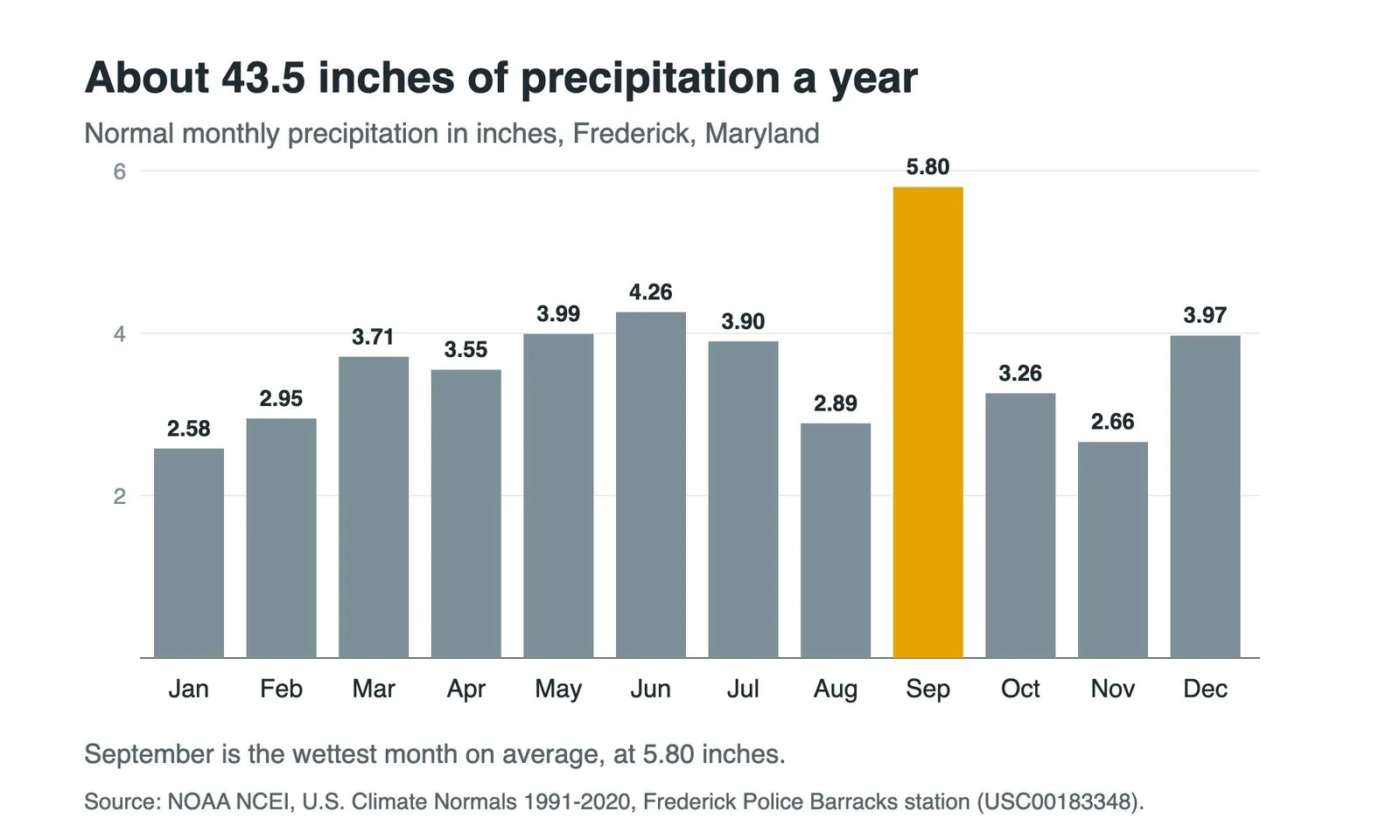
Normal monthly precipitation in Frederick, Maryland. Data: NOAA NCEI, U.S. Climate Normals 1991-2020.
A patio changes how that water moves. Grass and soil absorb some rainfall; pavers shed most of it to their edges. If a patio slopes toward the house, collects water where it meets a lawn, or drains onto a neighbor’s yard, the base under it can stay wet going into exactly the nights when it will freeze.
Some local contractors treat drainage as part of the design rather than an afterthought. A planning FAQ published by All American Lawn & Landscape, a veteran-owned company based in Walkersville, puts it plainly: “Hard surfaces change how rainwater moves across a yard. Planning should account for slope, where water will drain and neighboring properties before the base and surface elevations are finalized.” The company’s project records include a French drain installed along a privacy fence in Thurmont, built with perforated pipe, gravel and filter fabric, the same components practitioners describe for keeping water out from under hard surfaces.
What to ask before a patio goes in
None of this requires a homeowner to become an engineer. It does suggest a handful of practical questions worth asking any contractor during an estimate:
- How deep will the excavation go, and how thick will the compacted stone base be once it is finished?
- What kind of stone is used for the base, and will it be compacted in layers?
- Which direction will the patio slope, and where will the water go once it leaves the surface?
- Is filter fabric needed between the soil and the stone on this property?
- How will the edges be held in place so the outer pavers do not creep outward?
- Is there standing water or a soggy area nearby that should be fixed before the patio is built?
Maryland also requires most home improvement contractors to hold a license from the Maryland Home Improvement Commission, and the commission offers a public license search. Checking the number takes a minute and applies to any contractor, whatever the size of the job.
A small climate fact with long consequences
Frederick County is not known for brutal winters, which can make frost seem like a minor concern. The climate record suggests the opposite. A region where the temperature crosses the freezing line around 75 times a year, with more than 43 inches of precipitation feeding the soil, is a demanding place for anything built at ground level.
For homeowners investing in outdoor living space, the difference between a patio that stays flat and one that heaves comes down largely to work done before the first paver is laid. The weather data for that decision is public, long-term and specific to the county. The open question for the local market is how many buyers will ask about the base before they ask about the color of the stone.


