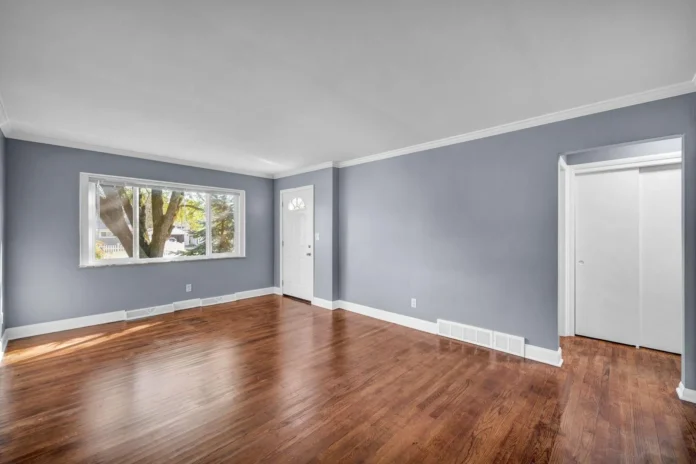

Drive through almost any neighborhood in Lake Charles, and a few houses catch the eye for the wrong reasons. The grass is long, the mailbox is full, and the blinds have not moved in months.
Federal housing data puts a number on that impression. Calcasieu Parish has a higher share of vacant homes than Louisiana as a whole, and far higher than the country. Most of those homes are not empty because they are waiting for a buyer or a renter.
Nearly One in Five Housing Units in the Parish Is Vacant
The Census Bureau’s American Community Survey counts every housing unit and asks if anyone lives there. Its latest five-year estimates cover 2020 through 2024.
Calcasieu Parish had 95,523 housing units in that period. Of those, 17,566 were vacant, which works out to 18.4% by our arithmetic.
The city of Lake Charles runs higher. The survey counts 40,742 housing units in the city and 8,665 vacant ones, or 21.3%.
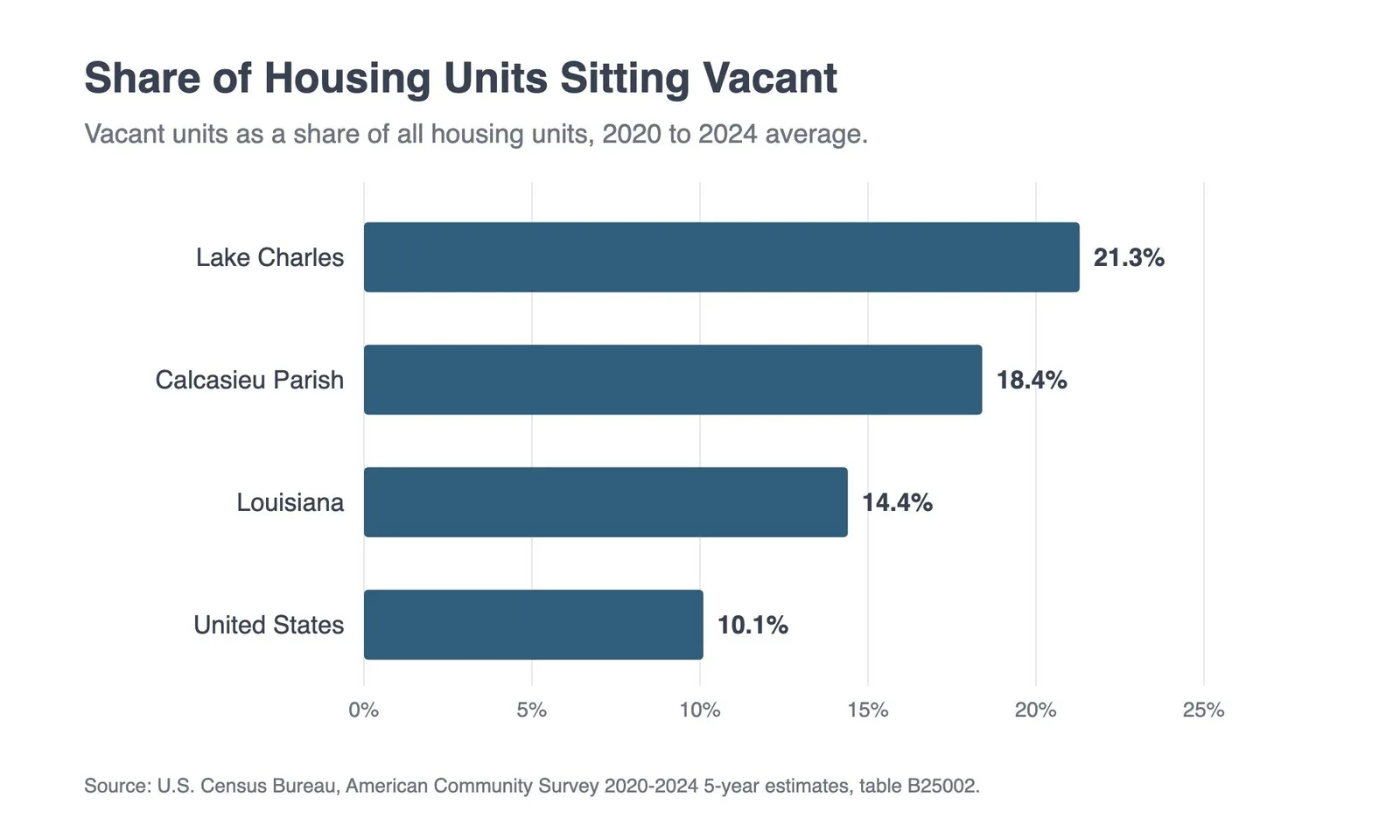
Vacant housing units as a share of all units, 2020 to 2024.
For comparison, the same table puts Louisiana at 14.4% and the United States at 10.1%. These are survey estimates with a margin of error. For Calcasieu, the Census Bureau lists a margin of plus or minus 1,106 vacant units, so the parish rate could sit a point or so higher or lower.
Most Empty Homes Are Not on the Market
A vacant house is not always a house for sale. The survey sorts every vacant unit into a status: for rent, for sale, rented or sold but not yet occupied, seasonal use, housing for migrant workers, or “other vacant.”
In Calcasieu Parish, 3,501 vacant units were for rent, and 919 were for sale. Together, that is about one in four vacant units.
The largest group by far is “other vacant.” The parish had 11,337 of them, or 64.5% of all vacant units. In Lake Charles, 5,848 of the 8,665 vacant units fell into the same category.
Nationally, other vacant units make up about 36% of vacant housing. Louisiana sits at about 56%. Calcasieu is higher than both.
What “Other Vacant” Covers
The category sounds like a leftover, but the Census Bureau breaks it down further. Its subject definitions list the reasons a unit can be classified as other vacant.
Some are about money. A unit counts as vacant for foreclosure when the owner’s mortgage, tax, or loan payments were no longer being made. That includes homes that are bank-owned, up for auction, sold at a sheriff’s sale, or taken for taxes.
Some are about the law. Legal proceedings cover homes held while an estate is settled, homes in probate, homes tied up in a divorce or eviction, and homes where the owner has died.
Others are about condition. A home can be vacant because it needs repairs, because repairs are under way, or because it has been abandoned.
A Statewide Look at the Reasons
The detailed reasons are published only in the one-year survey, and the Census Bureau does not release them for Calcasieu Parish on its own. The statewide figures still show the pattern.
A separate Census table on other vacancy status counts 165,163 other vacant units in Louisiana in 2024.
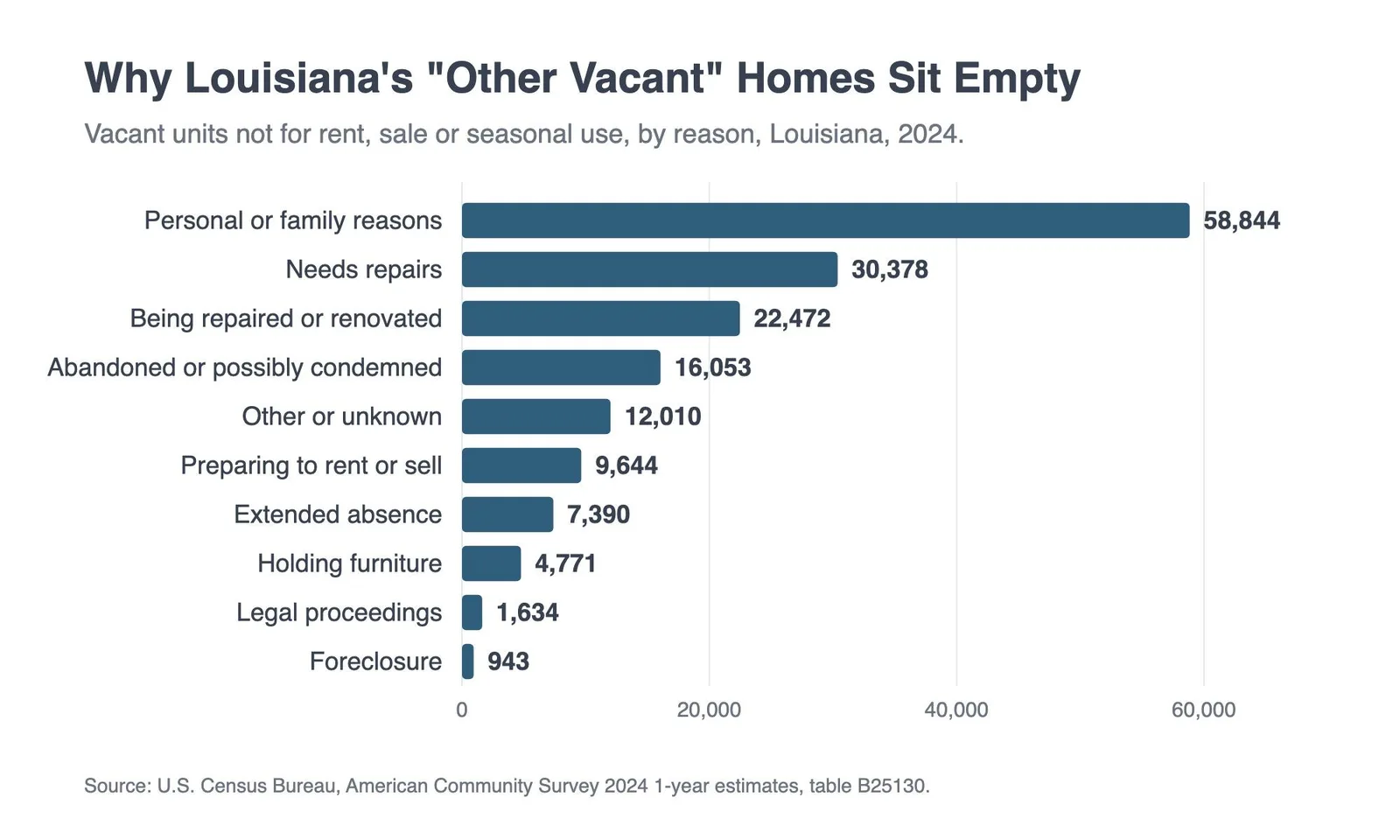
Louisiana other vacant units by reason, 2024.
Personal or family reasons lead the list at 58,844. That group includes owners who are deciding what to do with a house, keeping it for family use, or living in assisted care.
Repairs come next. The survey counts 30,378 units as vacant because they need repairs and 22,472 that were being repaired or renovated. Together, that is close to a third of the state’s other vacant homes.
Another 16,053 were abandoned or possibly condemned. Foreclosure, the reason many people assume first, accounts for only 943 units statewide, with a wide margin of error.
Why the Reason Matters for the House
Each reason leaves a house in a different state, and each one tends to leave something behind.
A home held for family reasons is often still furnished. An estate in probate may sit with decades of belongings until the heirs agree on what to keep. A home awaiting repairs can collect debris, damaged materials, and yard waste.
A foreclosed or bank-owned property has its own problem. The last occupants rarely empty it on the way out, and the lender or agent who now controls it usually needs it cleared before it can be listed, inspected, or sold.
The survey also tracks how long units sit. Its 2024 one-year table on vacancy duration counts 15,515 vacant units in Calcasieu Parish, and 10,161 of them had been empty for six months or more, about two in three by our arithmetic. The margins on those parish figures are wide, but the direction is clear: many of these houses have been closed up for a long time.
Getting a Vacant Property Ready Again
For owners, heirs, agents, and investors, the first steps tend to be the same.
- Confirm who has the legal right to clear the property and what has to stay.
- Photograph every room and the yard before anything is moved.
- Flag fixtures, appliances that convey, and anything set aside for the family.
- Work room by room so nothing is missed in a closet or behind furniture.
- Include the outside, since overgrowth and dumped debris affect a listing too.
Local junk removal crews handle much of this work. Klutter Krewe, a veteran-owned company serving Lake Charles, Sulphur, Westlake, Moss Bluff and nearby towns, describes clearing bank-owned and pre-sale properties so they can be listed, inspected or handed over.
The company says its crew works room by room, can schedule around a closing or listing date, includes the yard in the same job, and sweeps before it leaves. It also says the owner does not need to be at the property, as long as the crew has access and a clear list of what goes.
What the Numbers Suggest
The Census figures do not explain every empty house in Calcasieu Parish. They do show that vacancy here is common, and that most of it has little to do with a listing sign in the yard.
Behind many of those 11,337 other vacant units is a decision still waiting to be made: an estate to settle, a repair to fund, or a property a lender has to sell. Each one ends the same way, with a house that has to be cleared before anyone can move in.


