
Every house cleanout has the same moment. The rooms are full, the deadline is close, and the fastest plan is to put everything on a truck and let the landfill sort it out.
That plan works, but it has a cost that rarely shows up on an invoice. A solid dresser, a dining table with years left in it, and a refrigerator that still runs all end up in the same hole in the ground as a moldy mattress.
National data shows how common that outcome is, and why furniture in particular is so hard to keep out of the dump.
What the federal numbers show
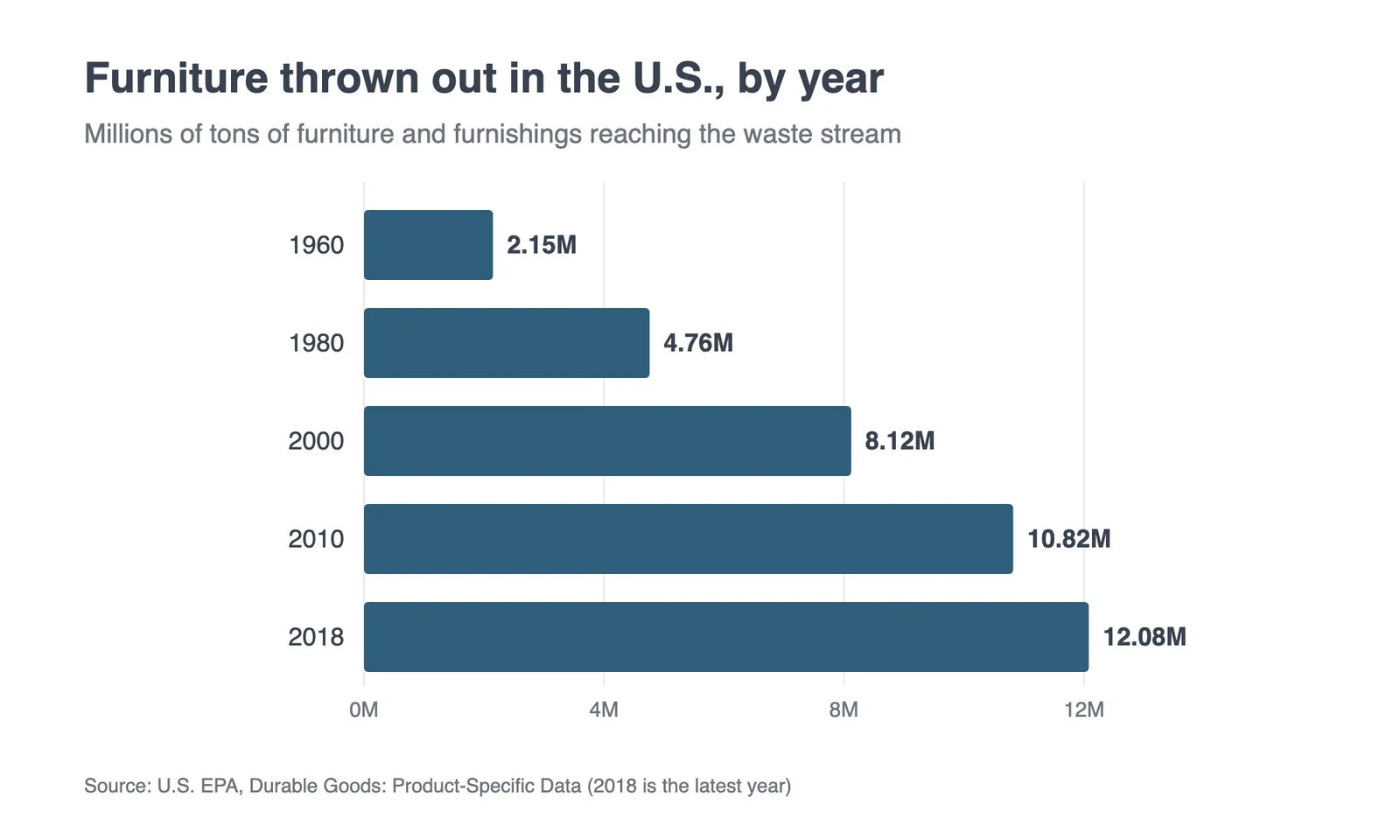
The U.S. Environmental Protection Agency tracks large household items in its Durable Goods: Product-Specific Data. Furniture and furnishings, a category that covers sofas, tables, chairs, and mattresses, reached 12.1 million tons in 2018, the most recent year in the series.
That figure was 2.2 million tons in 1960. The category has grown in every decade EPA reports since then.
Source: U.S. EPA, Durable Goods: Product-Specific Data.
EPA counts furniture at the end of its life, after a first owner and any second owners are done with it. So the number is not a measure of new couches. It measures what finally leaves a home for good.
Where it goes after that
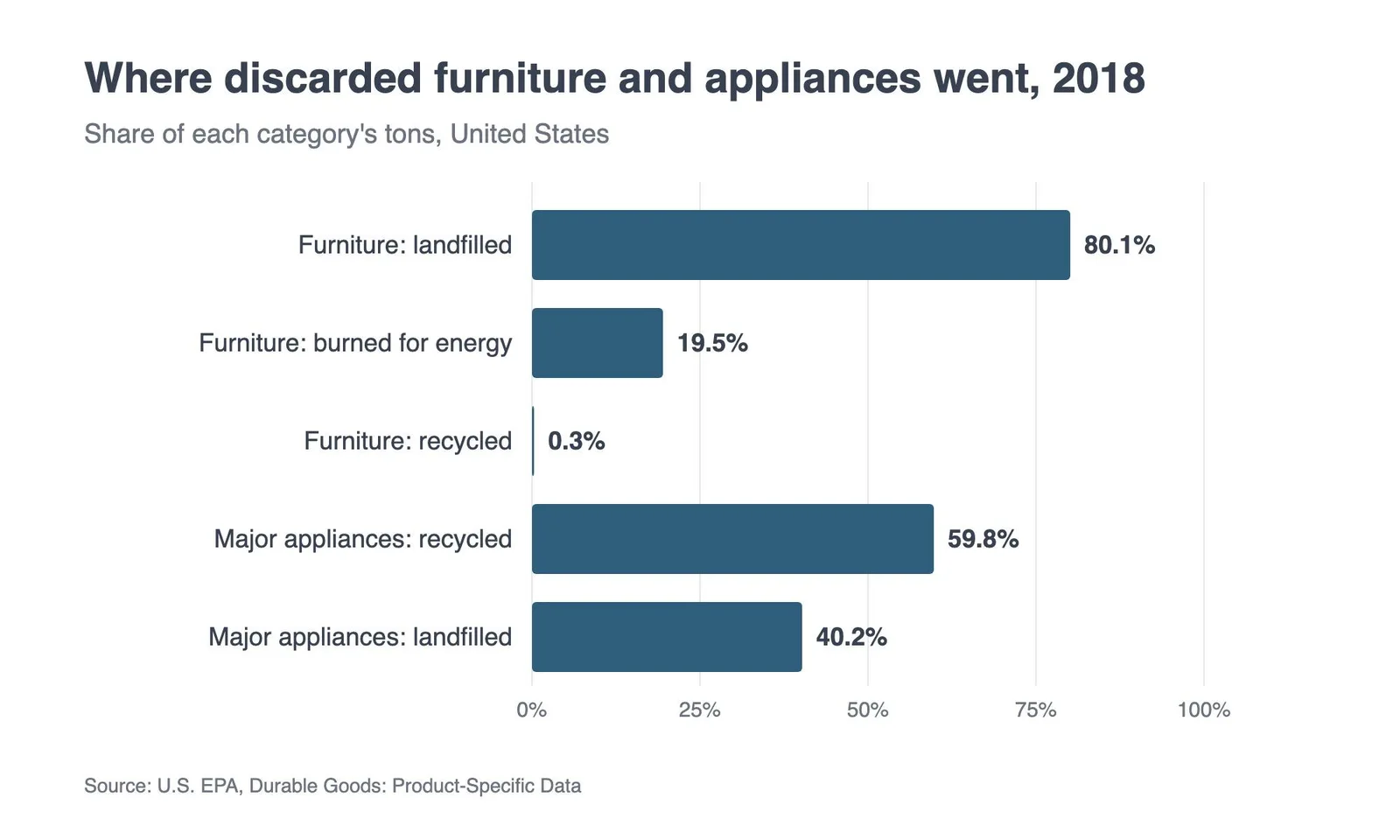
Here the data turns blunt. In 2018, 80.1 percent of discarded furniture and furnishings went to landfills, according to EPA. Another 19.5 percent was burned in facilities that recover energy.
Recycling barely registers. EPA lists about 40,000 tons recycled out of more than 12 million, and notes that outside of mattresses, it found no measurable data source for furniture recovery at all.
Major appliances tell a different story. Refrigerators, washers, and water heaters are mostly steel, and scrap steel has a market. EPA estimates that 59.8 percent of discarded major appliances were recycled in 2018, mostly through metal recovery after shredding.
Source: U.S. EPA, Durable Goods: Product-Specific Data.
Put those two lines side by side, and the gap is plain. A fridge has a built-in path out of the landfill because its metal is worth something. A wooden dresser has no such path unless a person decides it deserves one.
Why furniture is hard to save
Furniture is bulky, mixed, and slow to handle. A sofa combines wood, metal springs, foam and fabric, and none of those come apart easily. A haul-away crew paid by the load has every reason to keep moving.
Condition is the other problem. Thrift stores can only sell what a shopper will take home, so stained upholstery, water damage, pests, or heavy smoke odor usually mean a piece is done. Mattresses and box springs are turned down by many stores outright.
That leaves a large middle group: furniture that is sturdy and clean but out of style, or a piece with a loose leg that a little work would fix. That group is where the landfill numbers can actually move.
Reuse comes before recycling
EPA’s non-hazardous materials and waste management hierarchy ranks source reduction and reuse, including donating items, as the most environmentally preferred strategy, above recycling. An item used again doesn’t require new material, new manufacturing, or new shipping to replace it.
For furniture, reuse is almost the only option that works at scale, since so little of it can be recycled. A dining set that goes to a thrift store instead of a dump skips the landfill entirely, and someone who needs a table gets one for less.
The catch is that reuse depends on sorting, and sorting takes time most cleanouts don’t budget for.
What sorting looks like on a real job
One Denham Springs junk removal company has built its service around that sort. Second Life Cleanouts, owned and run by Jordan Mercier, takes the whole load in one visit and then goes through it piece by piece.
The company describes four places an item can land. Some things are kept by the owner. Working appliances and sturdy, clean furniture go to local community thrift stores. Pieces that need a repair go only to stores Mercier has vetted to fix them before resale, since he does not do repairs himself. Everything else is hauled off and disposed of properly.
The company does not yet name the thrift stores it uses on its website. It says each store will be listed once it agrees, and that each donation is posted to the company’s Facebook page with photos and the name of the store that received it.
What usually makes the cut
The lines are general, since every thrift store sets its own rules. Pieces that tend to be accepted include:
- Solid wood dressers, tables, chairs, bed frames and bookshelves
- Sofas and armchairs that are clean, with no tears, stains, or strong odors
- Working refrigerators, washers, dryers and stoves
- Lamps, mirrors, rugs and household goods in good shape
- Sturdy, clean outdoor furniture
The common turn-downs are used mattresses, anything with water damage, mold or pests, torn or broken upholstered pieces, and baby gear such as cribs and car seats that carry safety rules.
What households can do before a cleanout
Families planning a cleanout can make reuse more likely with a little preparation. Separate the clearly broken items from the good ones before the crew arrives, so the usable pieces are easy to spot.
Ask any hauler a direct question: what happens to the furniture after it leaves the house? A clear answer names where usable pieces go and admits that some of the load will still be thrown away.
Photos help too. A few pictures of each room let a hauler judge what is likely to be donated and give a better estimate before anyone shows up.
The honest limit
Not everything can be saved, and no hauler should claim otherwise. Broken furniture, worn-out appliances and general debris still need to go somewhere.
The national numbers are a reminder of how much of the rest goes there anyway. With 80 percent of discarded furniture headed to landfills, every sturdy table or working washer that finds a second home is one less piece added to that total.


