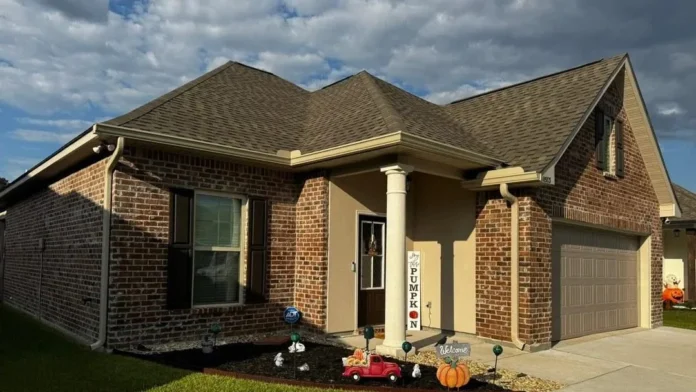

Seamless gutters on a brick home in Baton Rouge.
Most conversations about gutters start with how much it rains in a year. In South Louisiana, that number is big, but it is not what overwhelms a gutter.
What breaks a gutter system is the storm’s hardest hour. Planning around that hour, instead of the yearly total, changes how a home’s gutters should be sized and where the water should end up.
The Yearly Total Is Only the Background
Baton Rouge gets plenty of rain spread across the calendar. NOAA’s 1991 to 2020 climate normals for Baton Rouge Metropolitan Airport total about 62 inches of precipitation in an average year.
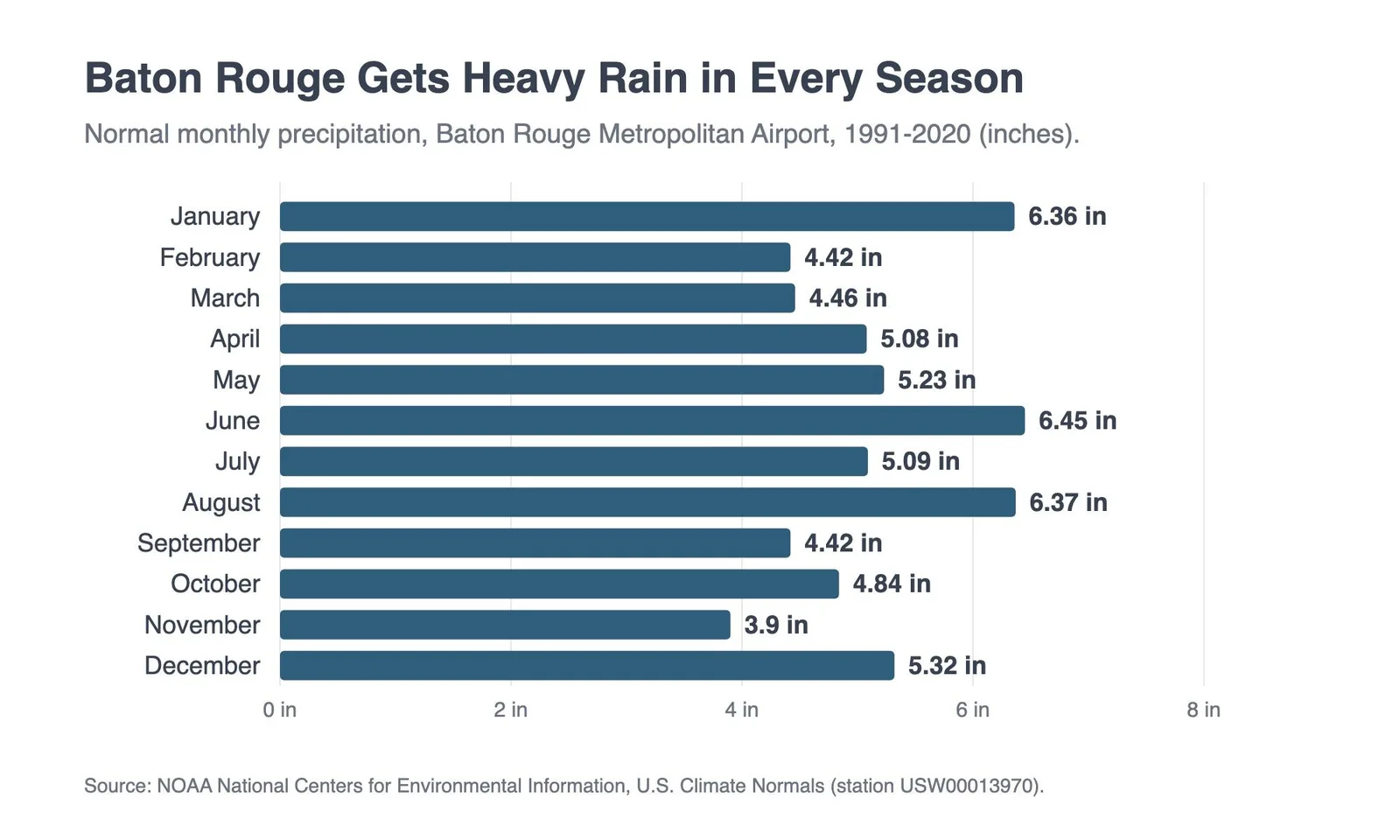
Baton Rouge averages about 62 inches of rain a year.
No month is reliably dry. The normals run from 3.90 inches in November to 6.45 inches in June, with January and August close behind June.
That steady total explains why gutters matter here. It doesn’t explain why they overflow, because rain doesn’t arrive evenly.
The Number That Matters: One Hard Hour
The better measure is how much rain can fall in a short burst. NOAA’s precipitation frequency estimates, published in NOAA Atlas 14, show how much rain to expect in a given window and how often.
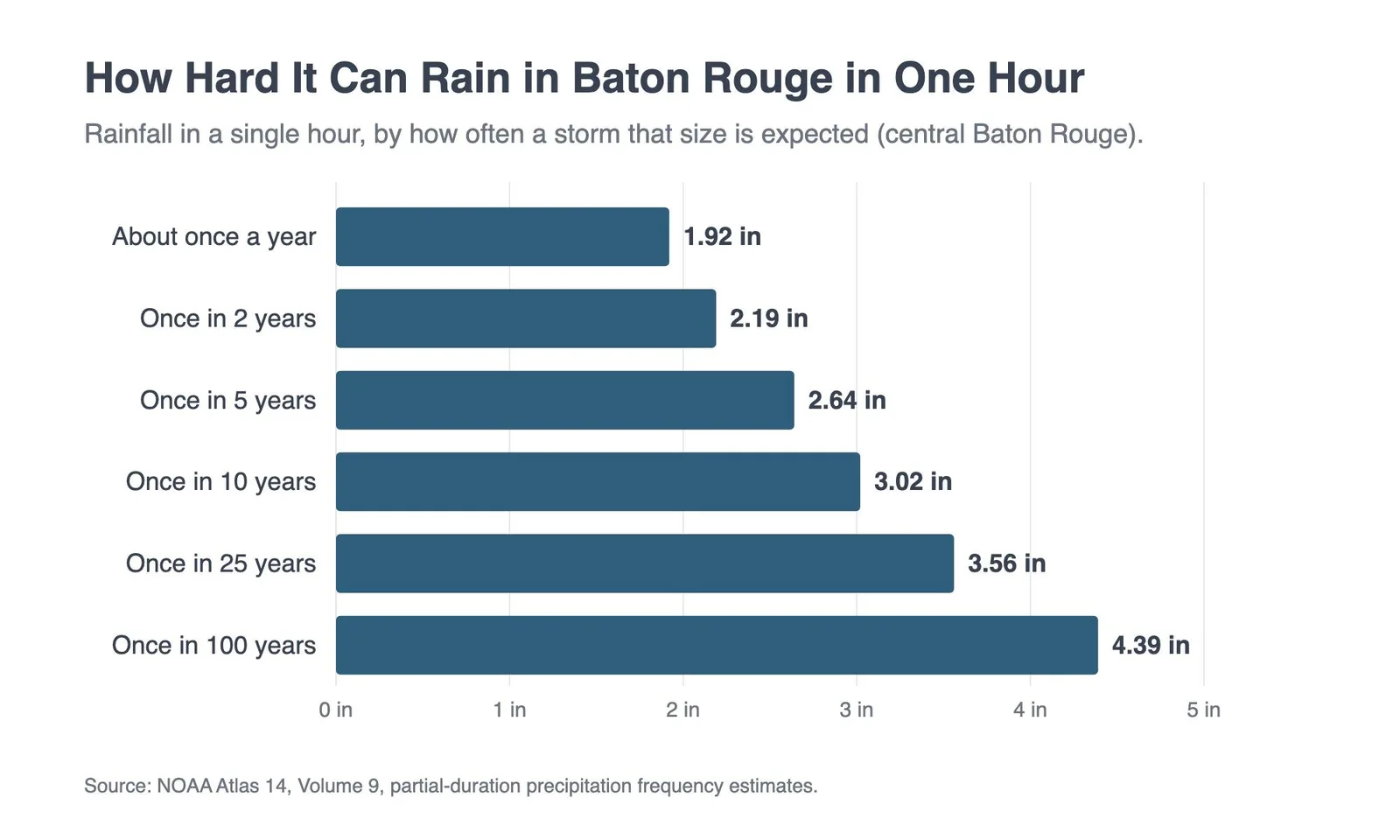
One-hour rainfall in central Baton Rouge, by how often to expect it.
For central Baton Rouge, Atlas 14 shows a one-hour rainfall of about 1.92 inches about once a year. A storm that drops about 3.02 inches in an hour is expected about once every 10 years, and 4.39 inches in an hour about once every century.
Longer storms stack up fast too. The same estimates put a 24-hour total of about 4.25 inches at roughly once a year and about 7.36 inches once every ten years, more than a typical month’s rain falling in a single day.
Those are not freak events. A gutter system on a home that will stand for decades can expect to see the once-a-year storm many times and the once-a-decade storm more than once.
What That Means for a Single Roof
The math is simple enough to do on a napkin. One inch of rain on 1,000 square feet of roof is about 83 cubic feet of water, or roughly 623 gallons.
At Baton Rouge’s once-a-year rate of 1.92 inches in an hour, that same 1,000 square feet sheds about 1,200 gallons in that hour, or about 20 gallons a minute. At the once-a-decade rate of 3.02 inches, it is closer to 1,880 gallons, about 31 gallons a minute.
Most homes have more than 1,000 square feet of roof, and the water does not split evenly. A valley or a long run can send far more than its share to one corner and one downspout.
Where Gutters Fail First
Overflow usually starts at weak points. Undersized gutters spill over the front edge, too few downspouts let water back up, and joints in sectional gutters often leak.
That is why seams draw so much attention. Sectional systems are pieced together from short lengths, while seamless gutters are formed in one continuous piece for each run, which removes those joints from the equation.
Debris makes everything worse during a heavy burst. Leaves and pine straw that narrow a downspout opening cut capacity at exactly the moment the system needs all of it.
Getting the Water Away From the House
Catching the water is only half the job. U.S. Department of Energy building guidance notes that a few inches of rain on a roof can produce several thousand gallons of runoff that must be channeled away from the foundation.
The same guidance recommends that gutters and downspouts terminate at least 5 feet from the foundation, or at least 10 feet away when they feed an underground catchment system. Water left near the house can saturate the soil and wick through the foundation, leading to problems with mold and rot.
The guidance also describes an option for homes without gutters: a grade-level rock bed around the house with a drain pipe in a lined trench beneath it, carrying water to a sloping grade at least 5 feet from the foundation or to a drywell. For most homes in the area, gutters with well-placed downspouts are a simpler way to achieve the same result.
A practical checklist for a Baton Rouge home:
- Look at where each downspout empties during a hard rain, not on a dry day.
- Add extensions or drain lines where water pools against the slab or crawlspace.
- Watch the busiest valleys and long runs for overflow over the front edge.
- Clear debris before storm season and after heavy leaf drop.
- Ask about downspout count and placement, not just gutter color.
Sizing and Installation Choices
Bigger gutters and more downspouts move more water, and the design should start with the roof and storms, not the catalog. A good installer measures each run, studies how water leaves the roof, and plans downspouts to match.
In the Baton Rouge area, Tiger Town Construction describes its approach to seamless gutters. It custom-forms 6-inch seamless aluminum gutters on site to match each run’s exact length, installs them with hidden hangers, and plans downspout placement before work begins.
The company says most of its gutter jobs finish in a day, with a final walkthrough to confirm everything drains.
Where Gutter Planning in South Louisiana Is Heading
The rain pattern behind all of this is well documented. Atlas 14 shows Baton Rouge’s short, intense bursts, and the yearly totals keep the ground wet between them.
That makes gutter planning less about matching a home’s trim and more about a few practical numbers: how hard it rains in an hour, how much roof drains to each corner, and how far the water travels before it reaches the ground.


