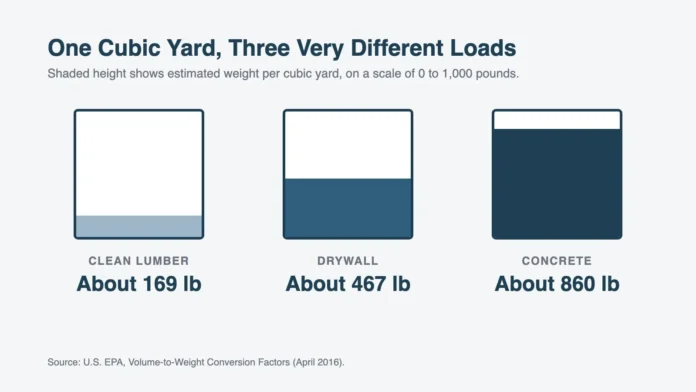

One cubic yard of debris can weigh five times as much depending on what it is.
Most people size a roll-off dumpster by eye. They picture the pile in the garage or the old kitchen cabinets on the lawn and pick a container that looks big enough.
That approach handles space. It often misses weight, and weight is what catches renovation and cleanout budgets off guard, in the Houston area and everywhere else. A container full of old framing lumber and a container full of broken concrete take up the same room, but they are not the same load.
Renovation Debris Is a Large, Heavy Waste Stream
Construction and demolition debris is tracked separately from household trash. The U.S. Environmental Protection Agency estimates that 600 million tons of it were generated in the United States in 2018, which is more than twice the amount of municipal solid waste generated that year.
Most of it comes from tearing things down. EPA says demolition represents more than 90 percent of total construction and demolition debris generation, while construction represents less than 10 percent.
The agency also describes the material itself as bulky and heavy. Its list includes concrete, wood, asphalt from roads and roofing shingles, gypsum from drywall, metals, bricks, and glass. Those are the same materials that come out of a bathroom gut, a roof replacement, or a garage cleanout.
Volume and Weight Are Not the Same Thing
Dumpsters are rented by volume, in cubic yards. Many rental quotes, though, also come with a weight allowance, and a heavy load can hit that limit while the container still looks half empty. The gap between the two measurements is where most surprises come from.
EPA’s volume-to-weight conversion factors put numbers on that gap. The April 2016 table estimates how many pounds one cubic yard of each material weighs, and its construction figures come largely from a California study of construction and demolition waste.
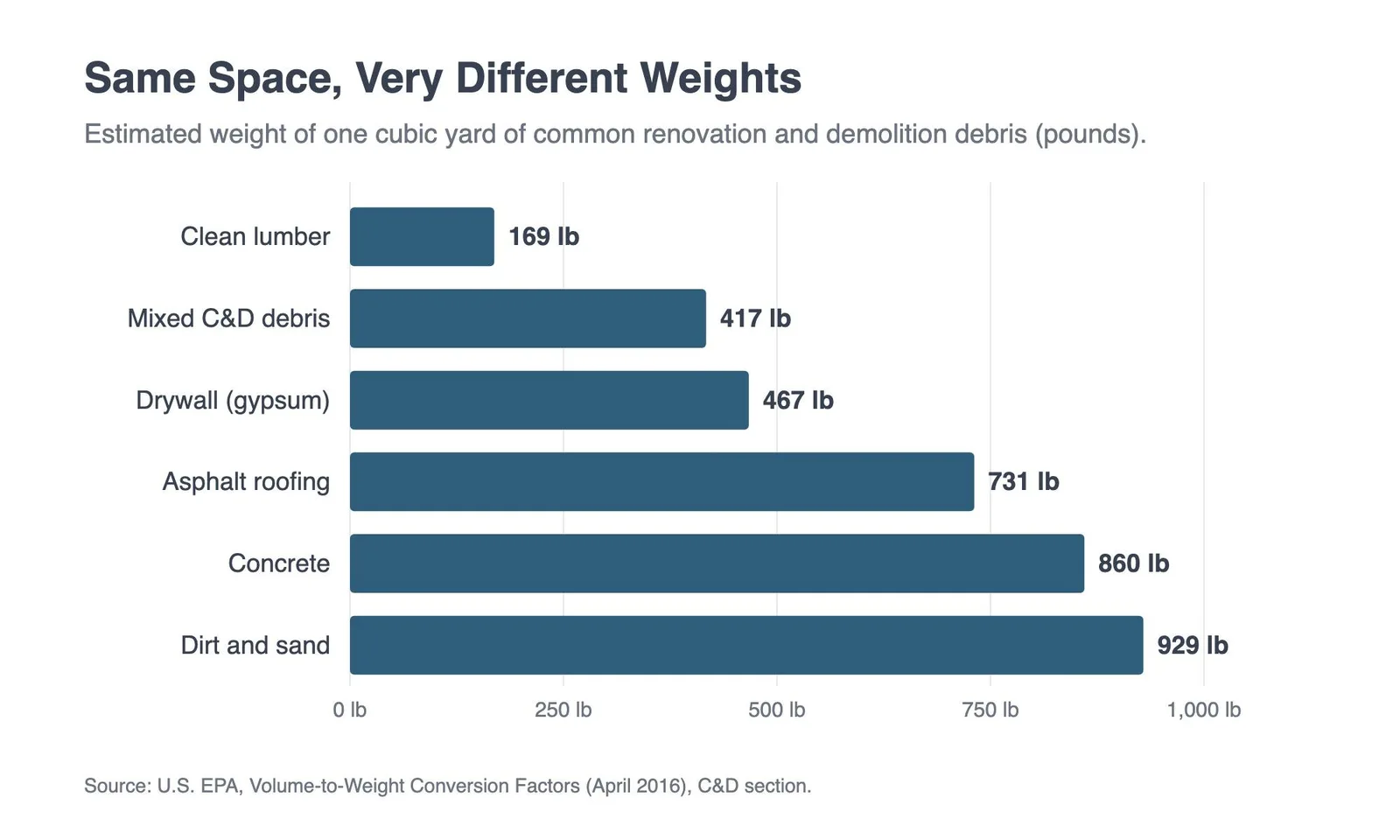
Estimated weight of one cubic yard of common renovation debris, from EPA’s conversion table.
The light end of the table is wood and soft goods. EPA lists clean dimensional lumber at about 169 pounds per cubic yard and carpet at about 147 pounds. Drywall comes in at about 467 pounds, and mixed construction and demolition debris at about 417 pounds.
The heavy end looks very different. Asphalt roofing is listed at about 731 pounds per cubic yard, concrete at about 860 pounds, and dirt and sand at about 929 pounds. Large rock sits at about 999 pounds, close to half a ton for a single cubic yard.
What a Full Container Can Weigh
Those factors add up quickly. Multiplying them by 10 cubic yards, a common small roll-off size, gives a rough sense of what a level-full container of one material would weigh.
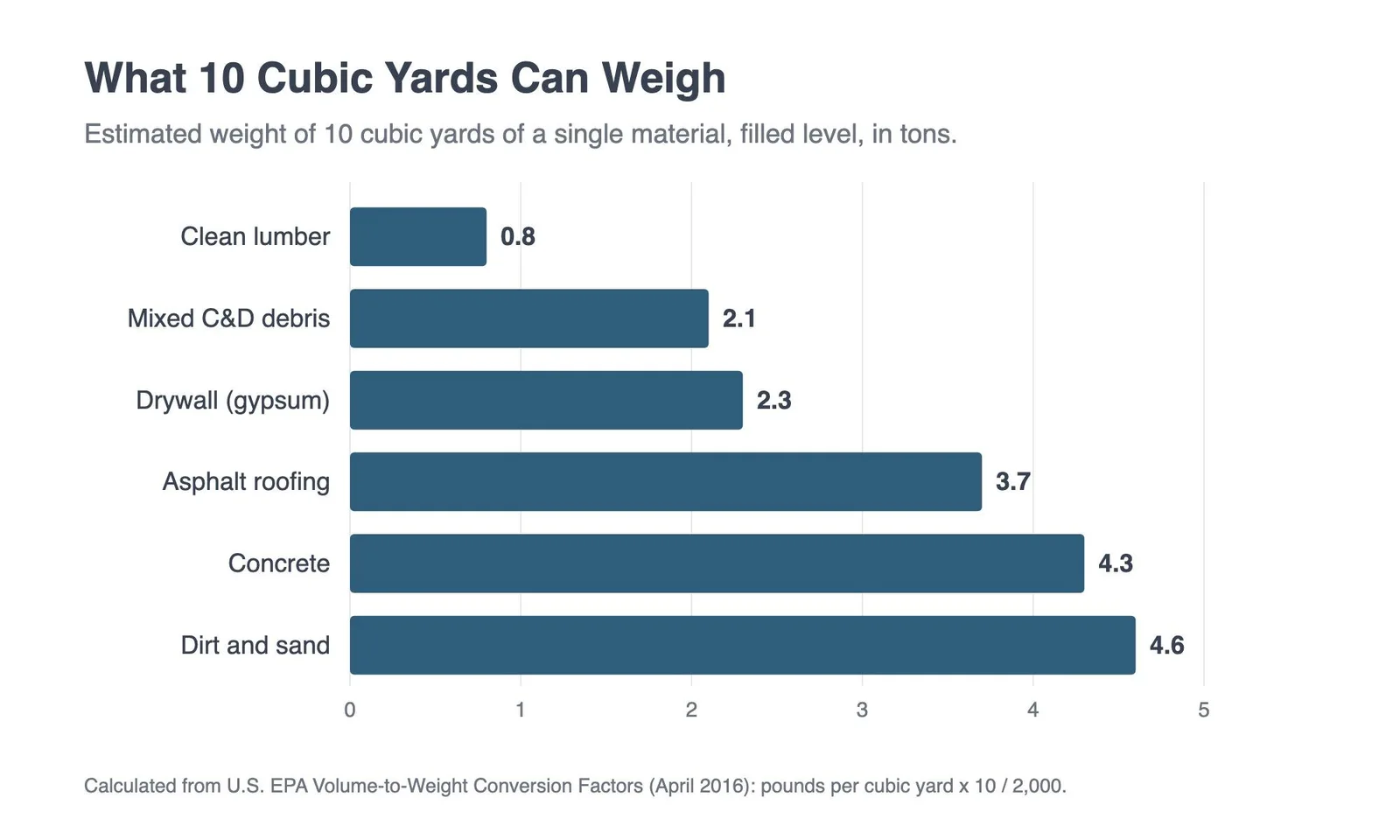
Ten cubic yards of concrete weighs about five times as much as ten cubic yards of lumber.
At EPA’s factors, 10 cubic yards of clean lumber works out to about 1,690 pounds, which is under a ton. The same space filled with drywall comes to about 4,670 pounds, or roughly 2.3 tons.
Fill it with old shingles and the estimate climbs to about 7,310 pounds, close to 3.7 tons. Concrete reaches about 8,600 pounds, or 4.3 tons, and dirt and sand about 9,290 pounds.
These are planning estimates, not scale tickets. Moisture, how tightly debris is packed and how much air sits between broken pieces all change the real number. After a wet week on the Gulf Coast, soaked drywall and carpet will not weigh what a dry table predicts.
The pattern still holds. With heavy debris, the weight allowance tends to run out long before the container looks full.
Matching the Container to the Debris
A few practical rules follow from the numbers:
- Roof tear-offs are dense. At about 731 pounds per cubic yard, shingles use up a weight allowance fast, so tell the hauler how many squares are coming off.
- Concrete, brick, dirt, and rock are the heaviest common materials. A smaller container that is only partly filled often suits them better than a large one.
- Drywall and mixed remodel debris sit in the middle. A whole-room renovation can fill a midsize container by volume while staying at a moderate weight.
- Lumber, furniture, carpet, and general cleanout clutter are bulky but light. That is where a larger container makes sense.
The most useful thing to give a hauler is a description of what is going in, not only how much. “A full roof replacement” or “a bathroom down to the studs” tells the dispatcher far more than “a big pile.”
What Cannot Go in the Container
Weight is not the only limit. Texas rules decide what landfills may take, and those rules follow the debris once it leaves the driveway.
The Texas Commission on Environmental Quality guide to the wastes landfills may accept, revised in February 2026, lists used oil and used oil filters, lead-acid storage batteries and regulated hazardous waste as prohibited at all four landfill types it covers.
The same guide shows that construction waste, demolition waste, brush, and rubbish are allowed at every one of those types. Type IV landfills, which handle that kind of debris, are not allowed to take putrescible and household wastes. That is one reason haulers ask about contents: clean remodel debris and a load mixed with kitchen garbage may need to go to different places.
A few other items need their own plan:
- Tires. The same state agency says homeowners can often drop off their own tires at a local government bulky trash event, or take them to a landfill that accepts them, which will usually charge a fee.
- Refrigerators, freezers, window air conditioners and dehumidifiers. EPA’s appliance disposal guidance notes that older units used ozone-depleting refrigerants and insulation foam, and that some municipalities require a professional to recover the refrigerant before they will accept the appliance.
- Leftover paint, pesticides, pool chemicals and car batteries. These belong in a household hazardous waste collection or a recycling drop-off, not mixed into renovation debris.
Planning a Project in the Baytown Area
A short checklist covers most renovation and cleanout jobs:
- List the main materials and estimate which are heavy and which are bulky.
- Keep concrete, brick and dirt separate when possible, since they may suit a smaller container.
- Pull out tires, batteries, appliances with refrigerant and household chemicals before loading starts.
- Ask the hauler what weight is included and how overages are handled before the container arrives.
- Plan where the container will sit, and check with the city before placing anything in a street or right-of-way.
For homeowners and contractors in Baytown and nearby Chambers and Liberty County communities, Tru-Tex Sanitation is one local hauler that offers roll-off dumpster rental in Baytown, with containers in several sizes for construction, demolition and cleanouts.
Whoever hauls the load, the goal is the same. Pick the container for what the debris weighs, keep the restricted items out, and the only surprise at the end of the job should be how much space the project freed up.


